
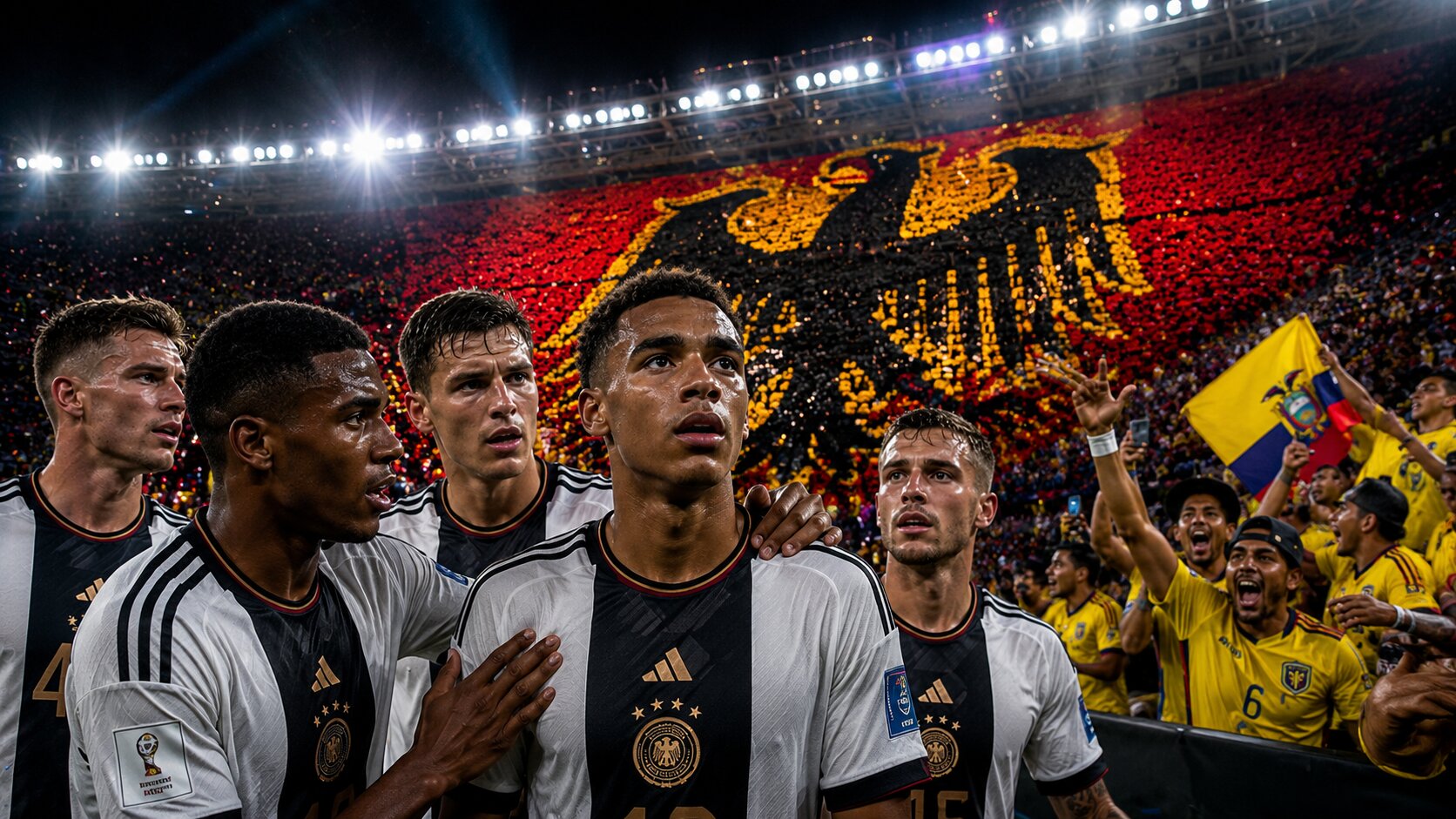
A Germany group stage analysis of this 2026 World Cup is bound to make its fans worry, particularly after its loss to Ecuador.
First Place Usually Brings Celebration. For Germany, It Also Brings Questions.
On paper, Germany’s group-stage campaign at FIFA World Cup 2026 appears successful.
Three matches.
Two victories.
One defeat.
Six points.
First place in Group E.
Qualification secured.
Mission accomplished.
Yet football rarely exists only on paper.
The mood surrounding Germany after its surprising 2-1 defeat to Ecuador is far more complicated than a typical group-winning campaign.
Germany entered the tournament as one of the favorites to challenge for the World Cup trophy. Through two matches, it largely justified those expectations. A crushing 7-1 victory over Curaçao showcased the team’s attacking potential, while a hard-fought 2-1 victory over Côte d’Ivoire demonstrated resilience against stronger opposition.
Then came Ecuador.
A team that many observers viewed as significantly less talented than Germany.
A team that entered the final group match as the underdog.
A team that ultimately exposed several weaknesses that Germany will need to address quickly if it hopes to lift the trophy in July.
The defeat does not erase Germany’s accomplishments.
Nor does it eliminate Germany from the list of contenders.
But it does introduce uncertainty at precisely the moment when elite teams want to project confidence.
The Good News: Germany Still Won the Group
Before analyzing the concerns, it is important to recognize what Germany achieved.
Winning a World Cup group is never easy.
Even traditional powers regularly stumble during the group stage.
Germany finished first because it accumulated enough points when it mattered.
The attacking quality displayed against Curaçao was exceptional.
The victory against Côte d’Ivoire demonstrated maturity and determination.
The team consistently generated scoring opportunities.
The midfield often controlled possession.
The defense generally looked organized.
Those strengths remain real.
One poor result does not erase two strong performances.
The challenge for Germany is determining whether the Ecuador defeat was merely an isolated setback or evidence of deeper problems.
Ecuador Exposed Germany’s Vulnerabilities
The most concerning aspect of the loss was not the result itself.
Upsets happen at every World Cup.
The concern lies in how the defeat occurred.
Ecuador entered the match with a clear strategy.
Remain compact.
Defend aggressively.
Attack quickly when opportunities emerged.
Germany struggled to adapt.
Possession remained heavily in Germany’s favor, but possession alone rarely wins knockout matches.
Too often, German attacks became predictable.
Too often, Ecuador found opportunities to counterattack.
Most importantly, Germany appeared vulnerable whenever the game became emotionally uncomfortable.
Championship teams usually respond well when things go wrong.
Against Ecuador, Germany appeared frustrated.
The passing became rushed.
The movement became less fluid.
Decision-making suffered.
That psychological response may concern German supporters more than the scoreline itself.
Jamal Musiala Remains Germany’s Most Important Player
Despite the disappointing result, Jamal Musiala continues to demonstrate why he is one of the brightest stars in world football.
Throughout the group stage, Musiala repeatedly created opportunities that few players could even imagine.
His ability to operate between defensive lines remains extraordinary.
His close control consistently destabilizes opposing defenses.
His creativity remains Germany’s most dangerous weapon.
Against Ecuador, Musiala still produced moments of brilliance despite the team’s struggles.
In many ways, the match reinforced his importance.
When Germany attacks effectively, Musiala is usually involved.
When opponents successfully limit his influence, Germany often becomes far less dynamic.
That reality creates both an opportunity and a challenge.
The opportunity is obvious.
Germany possesses one of the tournament’s most gifted attacking players.
The challenge is equally obvious.
Opponents now know exactly where much of Germany’s creativity originates.
Florian Wirtz and the Need for Greater Consistency
Another player carrying enormous expectations is Florian Wirtz.
At his best, Wirtz is capable of transforming matches through vision, intelligence, and technical excellence.
During portions of the group stage, he looked outstanding.
At other times, however, his influence faded.
Germany’s coaching staff must find ways to ensure that Musiala and Wirtz consistently complement one another.
When both are functioning at a high level, Germany becomes one of the most creative teams in the tournament.
When one struggles, the attack can become easier to contain.
The knockout rounds will require both stars to perform simultaneously.
That partnership may ultimately determine Germany’s fate.
Germany’s Attack Can Be Spectacular
The 7-1 victory over Curaçao was not an accident.
Germany possesses remarkable attacking talent.
The movement is intelligent.
The passing combinations are sophisticated.
The finishing ability remains impressive.
Few teams in World Cup 2026 can match Germany’s offensive ceiling.
When everything is working properly, Germany can overwhelm opponents quickly.
The challenge is sustaining that level against stronger opposition.
Curaçao allowed Germany space.
Ecuador did not.
The difference was significant.
Germany now faces a crucial question:
Can it produce the same attacking effectiveness when opponents defend with greater discipline?
The answer will become increasingly important as the knockout rounds begin.
Defensive Concerns Continue to Surface
For all of Germany’s attacking strengths, defensive questions remain.
The back line generally performed well during the group stage.
However, moments of vulnerability appeared in all three matches.
Against Curaçao, Germany’s overwhelming offensive superiority masked occasional defensive lapses.
Against Côte d’Ivoire, the defense bent but did not break.
Against Ecuador, those vulnerabilities became far more costly.
The issue is not necessarily individual quality.
Germany possesses talented defenders.
The issue is balance.
At times, Germany commits so many players forward that transitions become dangerous.
Elite opponents are likely to exploit those situations.
If Germany hopes to reach the semifinals or beyond, defensive organization must improve.
The Coaching Staff Faces Important Decisions
Germany’s coaching staff deserves credit for guiding the team to first place.
At the same time, the Ecuador defeat raises legitimate questions.
Were tactical adjustments made quickly enough?
Could substitutions have arrived earlier?
Was the team sufficiently prepared for Ecuador’s counterattacking strategy?
These questions do not imply failure.
Rather, they reflect the extraordinarily high standards associated with German football.
World Cups are often won through coaching decisions as much as player performances.
Germany’s staff now has valuable information.
The challenge is using that information effectively.
Great coaching staffs learn from defeats.
The coming knockout rounds will reveal whether Germany has done so.
Germany Group Stage Analysis: Video Germany vs Ecuador
The Paraguay Match Looms Large
Germany’s reward for winning Group E is a Round of 32 matchup against Paraguay. According to the tournament bracket, Germany remains favored, but recent events suggest nothing should be taken for granted.
Paraguay has already demonstrated resilience throughout the tournament.
The South Americans will undoubtedly study Ecuador’s blueprint carefully.
Expect a compact defensive structure.
Expect disciplined organization.
Expect quick transitions.
In other words, expect challenges similar to those Germany struggled with against Ecuador.
That makes the upcoming match extremely important.
A convincing victory would restore confidence.
A difficult performance would intensify concerns.
How Far Can Germany Go?
The answer depends on which Germany appears in the knockout stage.
If the version that defeated Curaçao and Côte d’Ivoire emerges, Germany can absolutely reach the semifinals and perhaps even the final.
The talent level is undeniable.
The attacking quality is elite.
The midfield contains some of the tournament’s best young players.
The overall depth remains impressive.
If, however, the Germany that lost to Ecuador reappears, the journey could end much sooner.
The margins between success and failure become increasingly narrow during elimination football.
One defensive mistake.
One missed opportunity.
One tactical miscalculation.
That is often all it takes.
Germany remains a contender.
But it no longer feels like an overwhelming favorite.
Final Thoughts
Germany’s group-stage campaign can best be described as successful but incomplete.
The objective was achieved.
First place was secured.
The knockout stage awaits.
Yet the final impression left by the group phase is not dominance.
It is uncertainty.
The victory over Côte d’Ivoire revealed resilience.
The destruction of Curaçao demonstrated attacking brilliance.
The defeat to Ecuador exposed vulnerabilities that stronger opponents will eagerly attempt to exploit.
Perhaps that is not entirely negative.
Sometimes a setback arrives at exactly the right moment.
Sometimes a defeat provides lessons that victories cannot.
Germany now has an opportunity to learn those lessons before the tournament’s most important matches begin.
The talent remains.
The ambition remains.
The path to the World Cup trophy remains open.
But after Ecuador’s stunning victory, Germany enters the knockout stage carrying both hope and caution.
The next match may reveal which emotion is more justified.
Keep up with match results, highlights, and analyses in TheWorldCup2026.com


