
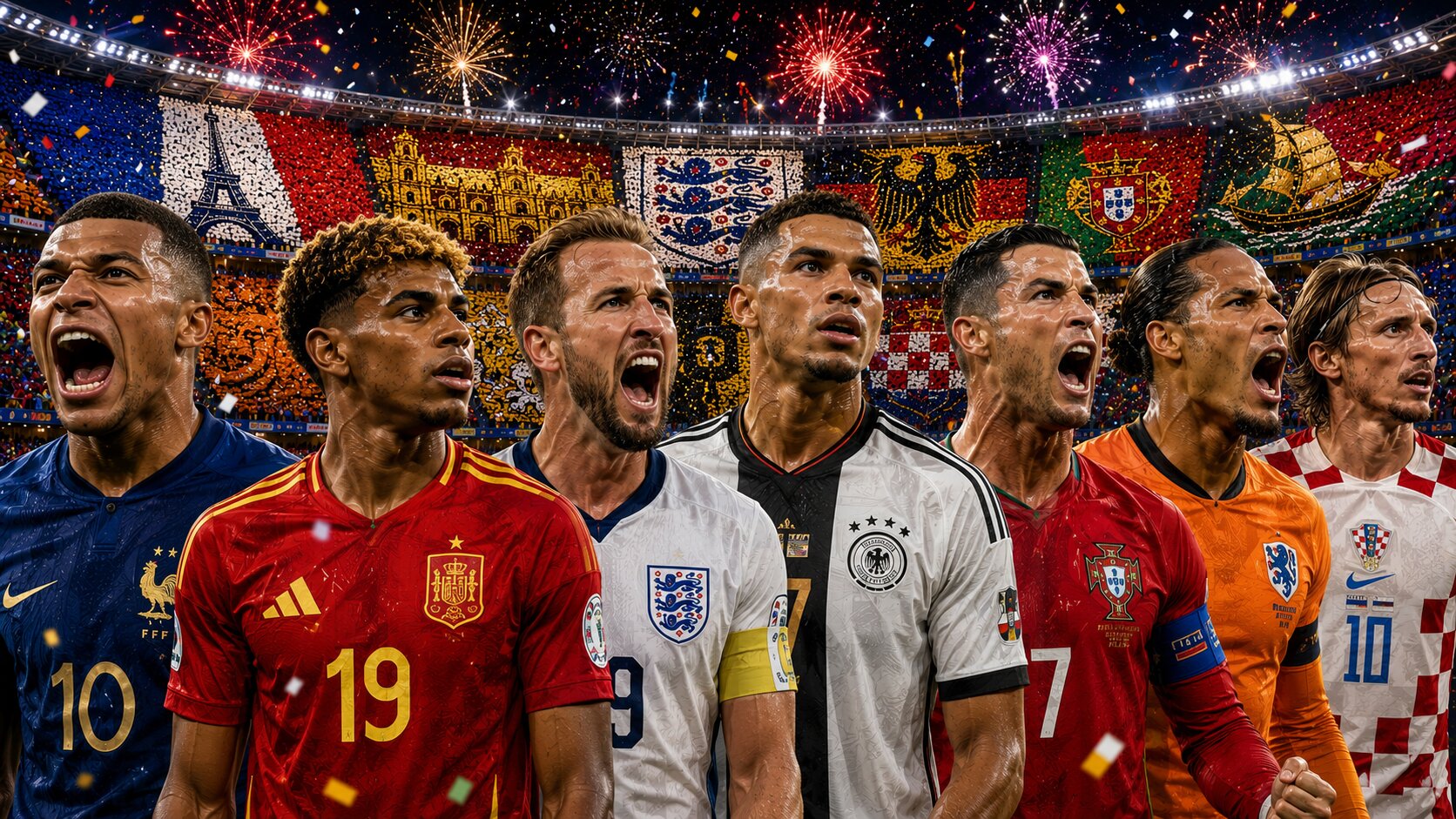
European Nations World Cup 2026: Group stage performance. Who are the winners and who are the losers?
Europe Arrived With the Most Teams and the Heaviest Expectations
Every World Cup begins with a familiar question.
Can the rest of the world close the gap with Europe?
For decades, European national teams have dominated international football through tactical sophistication, elite club development, coaching depth, and enormous player pools. World Cup 2026 has once again shown why UEFA remains the strongest confederation in the tournament.
But it has also shown something more complicated.
Europe has produced several of the strongest teams in the competition.
France looks like a favorite.
Spain has confirmed its status as a serious contender.
Germany remains dangerous despite worrying flaws.
England keeps winning without fully convincing.
Portugal has elite talent but enters the knockout stage with questions.
The Netherlands, Belgium, Croatia, Switzerland, Norway, Austria, Sweden, Bosnia and Herzegovina, Czechia, and Scotland have all added different chapters to the European story.
Some have impressed.
Some have survived.
Some have disappointed.
And a few have already been eliminated after campaigns that raised uncomfortable questions.
The overall image is clear:
Europe remains powerful, but not untouchable.
France: The Most Complete European Team So Far
No European nation has made a stronger statement than France.
Les Bleus have looked balanced, deep, confident, and frighteningly efficient. Their 4-1 victory over Norway was one of the clearest signs that France may be the team to beat at World Cup 2026.
Ousmane Dembélé’s hat trick in that match instantly became one of the defining individual performances of the tournament.
Yet France is not merely a team of individual brilliance.
Its strength comes from structure.
The midfield controls tempo.
The defense remains organized.
The attack offers multiple solutions.
If one star is contained, another can punish opponents.
That depth separates France from most of the field.
France’s greatest advantage may be its ability to win in different ways. It can dominate possession, counterattack, press high, or manage a match with maturity.
That flexibility is exactly what World Cup champions need.
Spain: Brilliant at Times, Resilient When Necessary
Spain has been one of the most fascinating European teams of the tournament.
At its best, La Roja has looked fluid, technical, and creative.
The emergence of Lamine Yamal has added excitement and unpredictability to a squad already known for passing intelligence and tactical control.
Spain’s dominant 4-0 victory over Saudi Arabia was one of the team’s finest performances, especially because it reestablished Spain as a World Cup favorite after earlier questions.
Yet Spain’s narrow 1-0 victory over Uruguay may have revealed something equally important.
Spain did not play brilliantly.
The match was physical, fragmented, and tense.
Uruguay disrupted rhythm and made the game uncomfortable.
Spain still found a way to win.
That matters.
Champions rarely win every match beautifully.
Sometimes they survive difficult nights.
Spain has now shown both sides of its identity:
Beauty and grit.
That combination makes La Roja extremely dangerous.
England: Winning, But Still Not Convincing
England remains one of the most talented squads in the tournament.
The problem is that talent has not always translated into convincing performances.
The Three Lions opened with an exciting 4-2 victory over Croatia, suggesting that this might finally be a more dynamic and fearless England team.
Then came a 0-0 draw against Ghana.
Then came a 2-0 victory over Panama that delivered the necessary result but little reassurance.
Jude Bellingham and Harry Kane have repeatedly rescued England.
Bellingham brings energy, leadership, and emotional authority.
Kane remains one of football’s most reliable finishers.
But the team around them has not consistently produced the fluid attacking football expected from a title contender.
England now faces DR Congo in the knockout stage.
On paper, England should advance.
But the warning signs are obvious.
If England plays slowly, becomes predictable, or relies too heavily on individual moments, stronger opponents will punish it.
The talent is there.
The performance level must rise quickly.
Germany: First Place With a Warning Label
Germany won its group, but the campaign has been anything but straightforward.
The 7-1 demolition of Curaçao showcased attacking power.
The victory over Côte d’Ivoire demonstrated resilience.
Then came the shocking defeat to Ecuador.
That loss changed the mood surrounding Germany.
Suddenly, a group winner looked vulnerable.
Jamal Musiala remains Germany’s most important player. His creativity, movement, and ability to destabilize defensive lines make him one of the tournament’s brightest young stars.
Florian Wirtz has also produced moments of high quality.
Yet Germany’s balance remains a concern.
At times, the team commits too many players forward and becomes vulnerable in transition.
The coaching staff now faces a difficult challenge:
Preserve Germany’s attacking identity while restoring defensive security.
If Germany solves that problem, it can go deep.
If not, the knockout stage may become dangerous very quickly.
Portugal: Elite Talent, Difficult Path
Portugal has one of the deepest attacking squads in the tournament.
Cristiano Ronaldo’s historic achievement of scoring in six different World Cups provided one of the emotional highlights of the group stage.
Bruno Fernandes remains the creative engine.
Bernardo Silva brings intelligence and control.
Rafael Leão offers speed and unpredictability.
Yet Portugal enters the knockout stage with mixed feelings after finishing second in its group behind Colombia.
The 0-0 draw against Colombia was one of the most entertaining matches of the tournament, proving Portugal can compete at a very high level.
But it also exposed a familiar issue.
Portugal created danger but failed to convert enough chances.
Now comes a brutal Round of 32 match against Croatia.
For a team with championship ambitions, Portugal’s road has become complicated early.
The talent is undeniable.
The margin for error has disappeared.
Croatia: Experience Still Matters
Croatia remains one of Europe’s most respected tournament teams.
Even as its golden generation ages, the team continues to display intelligence, composure, and competitive toughness.
Croatia’s group-stage performances were uneven, including a defeat against England.
But it still found a way into the knockout rounds, and that is exactly what experienced tournament teams do.
Against Portugal, Croatia will not fear the occasion.
It will try to slow the match, control emotional tempo, and frustrate Portugal’s attacking stars.
Nobody should underestimate Croatia in a knockout match.
This is a team built for pressure.
The Netherlands: Dangerous but Still Searching for Full Rhythm
The Netherlands has advanced with enough quality to be taken seriously.
Dutch football always carries a strong tactical identity, and this team is no different.
The squad has technical ability, defensive strength, and attacking creativity.
Yet the Netherlands has not fully exploded at this tournament.
There have been strong stretches, but also periods of inconsistency.
The upcoming clash with Morocco may become one of the most revealing matches of the Round of 32.
If the Netherlands controls possession and converts chances, it can advance.
If Morocco frustrates the Dutch rhythm, the match could become extremely complicated.
Belgium: Still Alive, Still Uncertain
Belgium continues to exist somewhere between contender and question mark.
The squad has talent and experience, but the aura of the great Belgian generation has faded.
Kevin De Bruyne remains influential when healthy and sharp.
Yet Belgium no longer feels as overwhelming as it once did.
The matchup against Senegal will test Belgium’s physicality and discipline.
This is exactly the kind of game Belgium must win if it wants to prove it remains relevant among Europe’s stronger teams.
A victory would restore belief.
A defeat would likely accelerate questions about the direction of Belgian football.
Norway: A Team Built Around a Superstar
Norway’s tournament has been defined by both promise and caution.
The decision to rest key players in the 4-1 defeat to France made strategic sense, but it also revealed the limits of Norway’s depth.
When Norway’s best players are on the pitch, especially Erling Haaland, the team can frighten anyone.
When they are absent, Norway looks far more ordinary.
That is not unusual.
Many national teams depend heavily on their biggest stars.
But Norway’s knockout-stage success will depend on whether it can build enough service, structure, and defensive balance around Haaland.
A dangerous team?
Absolutely.
A complete contender?
Not yet.
Switzerland and Austria: Quietly Competitive
Switzerland and Austria have both reinforced the reputation of Central European football.
Neither team may dominate headlines, but both are tactically serious, disciplined, and capable of punishing mistakes.
Switzerland remains organized and experienced.
Austria has shown energy, pressing quality, and collective belief.
Their challenge is similar:
Can they move from being difficult opponents to genuine knockout threats?
Against elite teams, organization alone may not be enough.
They need decisive attacking moments.
The Biggest European Disappointments
Several European teams failed to meet expectations.
Czechia’s campaign ended with frustration, especially after the heavy 3-0 defeat to Mexico.
Scotland showed pride but struggled against elite opposition, including the 3-0 loss to Brazil.
Some European third-tier contenders appeared competitive in stretches but lacked the cutting edge required at this level.
The lesson is clear:
Europe remains deep, but not every European nation is closing the gap with the top tier.
The difference between France, Spain, Germany, England, and Portugal and the rest of UEFA remains significant.
Outstanding European Players
Several European stars have shaped the tournament.
Ousmane Dembélé
His hat trick against Norway was one of the tournament’s great individual displays.
Lamine Yamal
The Spanish teenager continues to look fearless and mature beyond his age.
Jude Bellingham
England’s emotional and tactical leader.
Harry Kane
Still England’s most reliable goal scorer.
Jamal Musiala
Germany’s most creative and dangerous player.
Cristiano Ronaldo
Still writing World Cup history.
Erling Haaland
The player every opponent must plan around when facing Norway.
What Have We Learned About European Football?
Europe remains the deepest confederation in the tournament.
Its top teams possess elite coaching, tactical structure, and world-class individual talent.
However, World Cup 2026 has also shown that the rest of the world is closing in.
African teams are more organized.
South American teams remain dangerous.
CONCACAF nations such as Canada, Mexico, and the United States are more competitive than ever.
Europe still leads.
But it cannot assume dominance.
The knockout stage will test whether European power translates into trophies.
Final Thoughts
The European story at World Cup 2026 is one of strength mixed with uncertainty.
France looks like a champion.
Spain looks balanced and dangerous.
Germany remains talented but flawed.
England keeps winning without convincing.
Portugal possesses elite weapons but faces a brutal path.
The Netherlands, Belgium, Croatia, Norway, Switzerland, and Austria all remain capable of making noise.
Europe has once again placed many teams into the knockout stage.
But numbers alone do not win World Cups.
The coming matches will reveal which European teams are merely strong and which are truly great.
For now, France and Spain look like Europe’s best hopes.
Germany, England, and Portugal remain dangerous.
And the rest of the continent continues fighting to prove that European football still owns the biggest stage in the world.
Keep up with news, highlights and much more in TheWorldCup2026.com


