
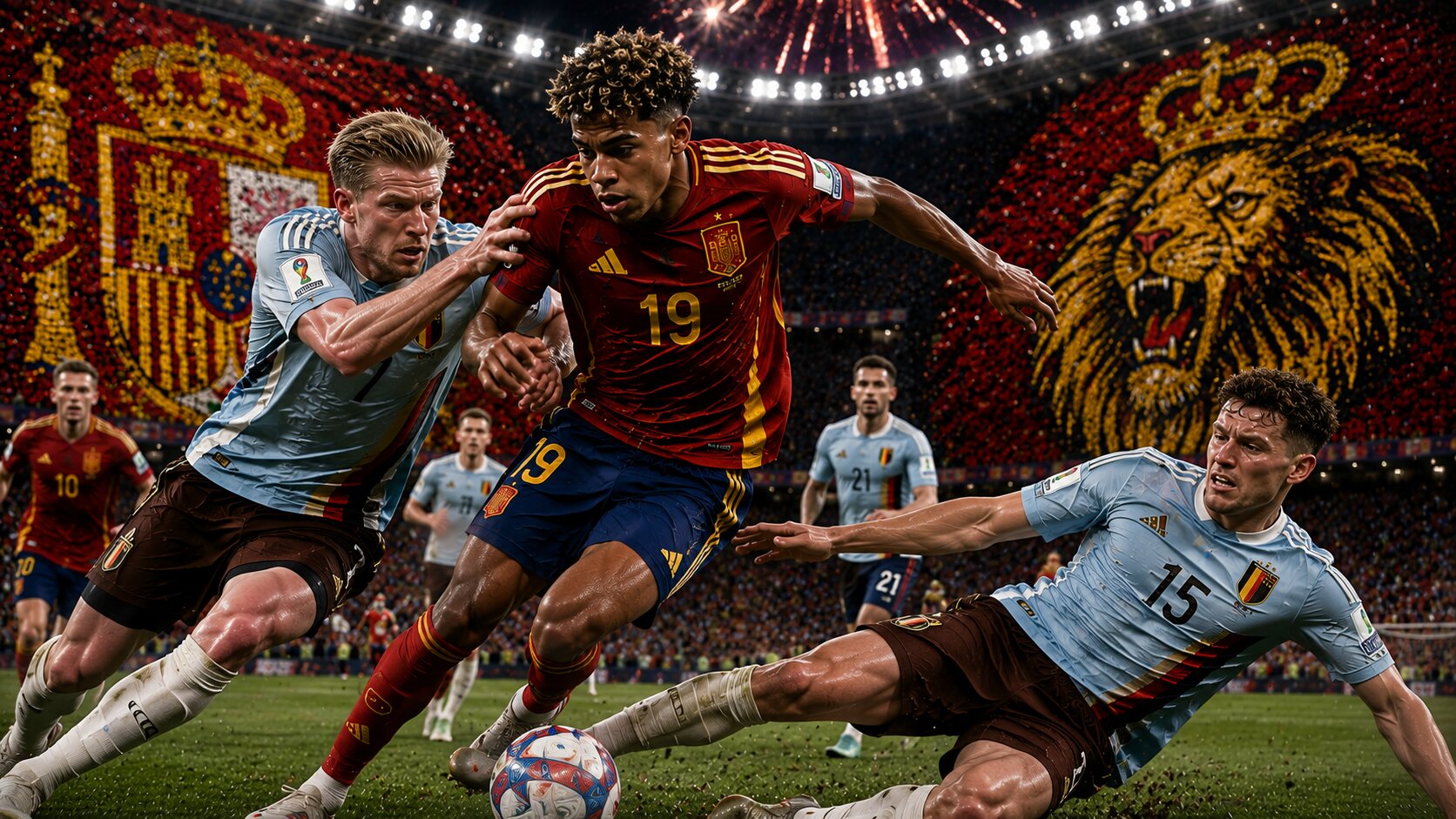
Spain 2-1 Belgium World Cup 2026 Analysis: La Roja Survives a Classic and Marches Into a Titanic Semifinal Against France
Spain is headed to the semifinals of the 2026 FIFA World Cup after defeating Belgium 2-1 in a thrilling quarterfinal that lived up to every expectation. For long stretches, this felt less like a football match and more like a heavyweight championship fight. Two elite European powers traded possession, attacks, tactical adjustments, and moments of brilliance before Spain ultimately emerged victorious.
The result sends Spain into a blockbuster semifinal against France, a matchup many observers believed could have been the final itself. For Belgium, the defeat brings an end to an impressive tournament run that included a dominant 4-1 victory over the United States and several performances that reminded the world why the Red Devils remain one of international football’s most dangerous teams.
This quarterfinal had everything: tactical intrigue, spectacular individual performances, dramatic momentum swings, and enough quality on the field to satisfy even the most demanding football purists.
A High-Intensity Opening
The match began at a furious pace.
Unlike some knockout matches where teams spend the opening minutes cautiously probing for weaknesses, Spain and Belgium immediately showed their intentions. Belgium pressed aggressively, attempting to disrupt Spain’s buildup before the midfield could establish control.
Spain responded with its trademark possession game.
Rodri dropped deep to receive the ball, while Pedri constantly searched for spaces between Belgium’s midfield and defensive lines. Lamine Yamal stretched the field wide, forcing Belgian defenders to make difficult decisions about when to step forward and when to protect space behind them.
The first fifteen minutes established the central theme of the match.
Spain would attempt to control possession and tempo.
Belgium would attempt to disrupt rhythm and create danger through direct transitions and physical pressure.
Both strategies produced moments of success.
Belgium’s Physical Approach Creates Problems
Belgium entered the match believing it could challenge Spain physically, and for significant stretches that strategy worked.
The Belgian midfield contested every ball aggressively. Spain’s players found themselves under constant pressure whenever they attempted to build through central areas.
Unlike Portugal, which often struggled to disrupt Spain’s passing rhythm in the previous round, Belgium succeeded in making the match uncomfortable.
The Red Devils frequently forced Spain into hurried decisions and prevented La Roja from establishing the complete control that has characterized many of its victories.
Belgium’s attacking transitions also looked dangerous.
Every turnover seemed to create a potential opportunity. The Belgian attackers immediately looked forward, testing Spain’s defensive organization before it could fully recover.
This willingness to attack quickly prevented Spain from committing excessive numbers forward.
Spain’s Midfield Eventually Takes Control
Despite Belgium’s energetic start, Spain gradually began imposing its preferred style.
Rodri delivered another masterclass in midfield management.
His positioning allowed Spain to maintain possession even when Belgium pressed aggressively. Time and again, Rodri provided passing options, broke lines with intelligent distribution, and helped Spain escape difficult situations.
Pedri was equally influential.
The Barcelona midfielder repeatedly found spaces that Belgium struggled to close. His movement between the lines created uncertainty throughout the Belgian defensive structure and opened passing lanes for teammates.
As the first half progressed, Spain increasingly forced Belgium to defend deeper.
The possession statistics began shifting decisively in Spain’s favor.
More importantly, the quality of Spain’s chances improved.
The breakthrough felt increasingly inevitable.
Lamine Yamal Delivers Again
The opening goal arrived through one of the tournament’s brightest stars.
Lamine Yamal has repeatedly demonstrated why many believe he represents the future of Spanish football, and once again he produced a moment worthy of the occasion.
The young winger combined technical brilliance with composure beyond his years. After receiving the ball in a dangerous position, he attacked defenders directly, creating the kind of individual advantage that can change a knockout match.
Belgium’s defensive structure momentarily fractured.
Spain exploited the opening.
The finish was clinical.
The goal rewarded Spain’s patience and highlighted one of Belgium’s few weaknesses: vulnerability when individual defenders are forced into difficult one-on-one situations.
For Yamal, it was another defining moment in a World Cup that is transforming him into a global superstar.
Belgium Refuses to Collapse
Many teams would have struggled emotionally after conceding against a possession-heavy opponent like Spain.
Belgium responded differently.
The Red Devils increased their intensity and began committing more players forward. Their midfield challenged more aggressively, while the attack became increasingly direct.
The response eventually produced an equalizer.
The goal reflected Belgium’s resilience and attacking quality. Spain’s defensive organization, so impressive throughout the tournament, finally showed a moment of vulnerability.
Belgium capitalized immediately.
Suddenly, the match was level again.
The equalizer transformed the atmosphere.
What had been gradually becoming a Spanish-controlled contest now became an open battle once more.
For neutral observers, it was magnificent entertainment.
For the coaching staffs, it was an invitation to begin making adjustments.
Tactical Chess Match
The second half became a fascinating tactical duel.
Spain’s coaching staff recognized that Belgium’s physical pressure was disrupting central combinations. As a result, Spain increasingly utilized wider areas and encouraged more movement from its attacking players.
Belgium adjusted as well.
The Red Devils became slightly more conservative when pressing high, preferring to maintain defensive organization rather than risk exposing themselves to Spain’s technical attackers.
These changes created a more balanced match.
Neither side completely controlled proceedings.
Instead, the game became defined by moments.
One interception.
One successful dribble.
One defensive recovery.
One accurate pass.
At this stage, the quarterfinal felt destined to be decided by a single piece of brilliance.
Rodri and Pedri Dominate the Midfield Battle
While attacking players often receive the headlines, Spain’s victory was built largely in midfield.
Rodri delivered one of the finest performances of the tournament.
His influence extended far beyond possession statistics. He controlled tempo, organized defensive transitions, and consistently placed teammates in advantageous positions.
Whenever Belgium appeared ready to seize momentum, Rodri restored order.
Pedri complemented him perfectly.
The young midfielder repeatedly found creative solutions in crowded spaces. His vision allowed Spain to bypass pressure and create opportunities that did not appear obvious to anyone else on the field.
Together, they gradually tilted the match in Spain’s favor.
Belgium remained dangerous, but Spain increasingly controlled where and how the game was played.
That subtle dominance eventually became decisive.
Video Spain 2-1 Belgium World Cup 2026 Analysis, Goals and Extended Highlights
The Winning Goal
The decisive moment arrived during one of Spain’s strongest periods.
After patiently circulating possession, Spain finally created the opening it had been searching for. Quick movement, intelligent positioning, and precise passing combined to break through Belgium’s defensive structure.
The finish was ruthless.
Belgium’s goalkeeper had little chance.
The goal immediately altered the strategic landscape.
Belgium now needed another equalizer.
Spain needed to protect its advantage.
The final stages became a test of discipline, concentration, and nerve.
Belgium’s Final Push
To their credit, Belgium never stopped attacking.
The Red Devils committed numbers forward and generated several dangerous moments. Their physicality, aerial strength, and attacking ambition forced Spain’s defenders to remain fully focused until the final whistle.
Belgium’s performance in defeat deserves enormous respect.
Unlike some teams that become cautious in major knockout matches, Belgium continued pursuing the game. The players believed they could force extra time, and their commitment was evident.
Spain, however, defended intelligently.
Rather than retreating excessively, La Roja continued managing possession and forcing Belgium to expend energy chasing the ball.
When the final whistle arrived, Spain had survived one of its most difficult tests of the tournament.
Outstanding Performers
Spain
Lamine Yamal was once again extraordinary. His pace, creativity, and willingness to attack defenders transformed the match repeatedly.
Rodri may have been the most important player on the field. His ability to control rhythm allowed Spain to navigate difficult periods and maintain composure under pressure.
Pedri provided creativity and intelligence throughout the match, consistently helping Spain progress through Belgium’s defensive structure.
Belgium
Belgium’s attacking players consistently threatened Spain and demonstrated why the Red Devils entered the quarterfinal with enormous confidence.
The Belgian midfield also deserves praise for its aggressive approach and willingness to challenge Spain physically.
Even in defeat, Belgium showed the quality of a team capable of competing with any nation in world football.
Video Spain 2-1 Belgium World Cup 2026 Analysis: How Spain Eliminated Belgium
What This Means for Spain
This victory may prove more valuable than Spain’s previous wins.
Against Austria, Spain dominated.
Against Portugal, Spain controlled.
Against Belgium, Spain suffered, adapted, and survived.
Champions often require different types of victories.
This was Spain’s resilience victory.
The match demonstrated that La Roja can overcome physical pressure, withstand momentum swings, and find solutions against elite opposition.
Those qualities will be essential against France.
What This Means for Belgium
For Belgium, the defeat is heartbreaking but not embarrassing.
The Red Devils arrived in excellent form and pushed one of the tournament favorites to the limit. Their victory over the United States remains one of the most dominant performances of the knockout rounds.
This generation may not have reached the semifinal, but it reminded the football world that Belgium remains a major international force.
The challenge now will be transforming these strong performances into future tournament success.
Looking Ahead: Spain vs France
The semifinal against France promises to be one of the defining matches of World Cup 2026.
Spain enters with momentum and confidence.
France enters as perhaps the tournament’s most complete team.
Spain will likely enjoy more possession than most of France’s previous opponents, but France possesses the pace and attacking quality to punish mistakes ruthlessly.
Rodri and Pedri versus France’s powerful midfield may determine control of the match.
Yamal’s ability to challenge defenders could be decisive.
France, meanwhile, will attempt to exploit Spain’s occasional vulnerability in transition.
At the moment, the semifinal feels almost perfectly balanced.
What is certain is that Spain’s victory over Belgium has prepared it for the challenge ahead.
La Roja survived one of the toughest quarterfinals imaginable.
Now an even greater test awaits.
Stay alert! Stay informed in TheWorldCup2026.com!


