
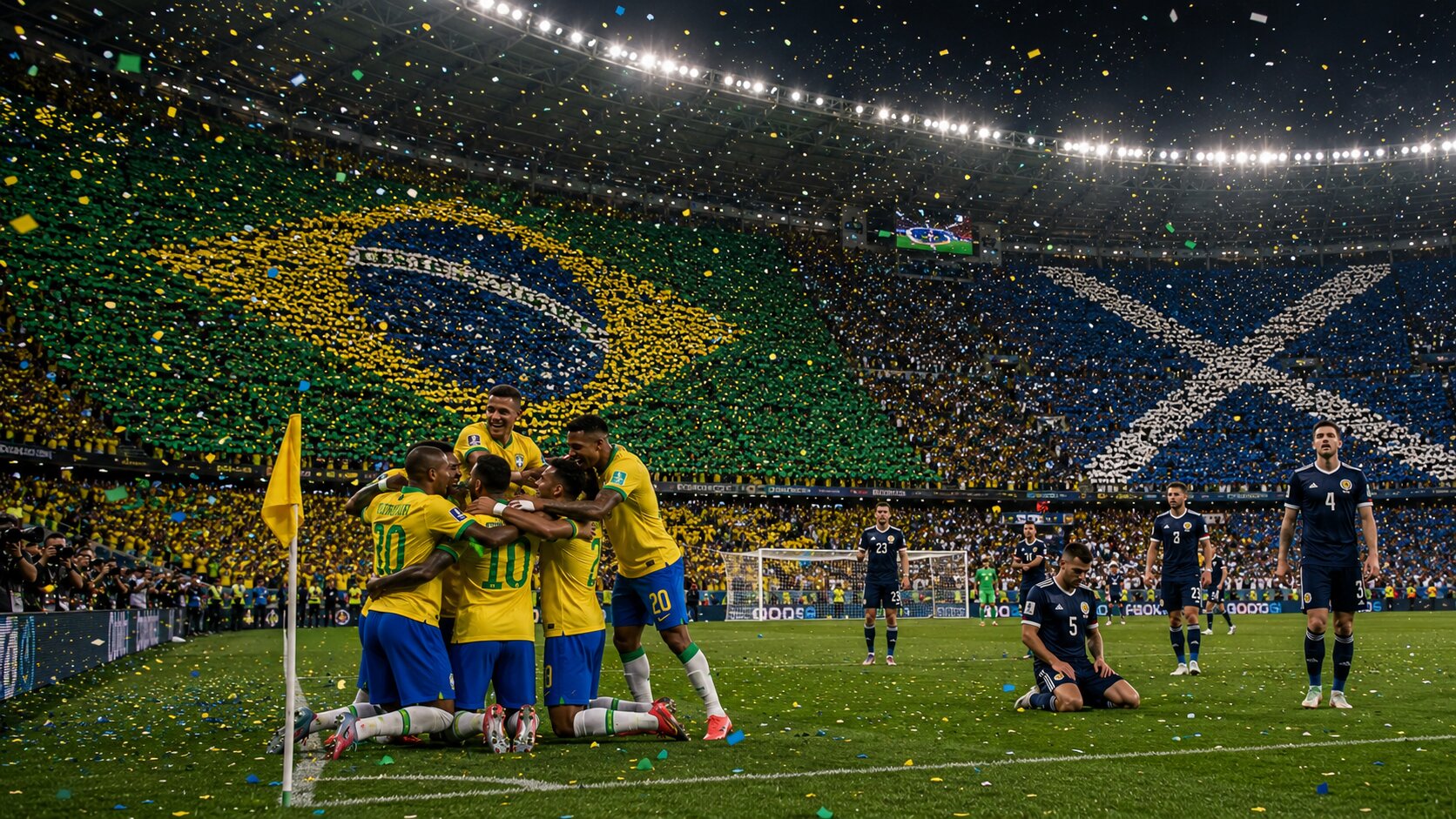
Brazil 3-0 Scotland World Cup analysis of a sensational Brazilian performance.
Brazil Needed a Statement. Against Scotland, They Delivered One.
There are victories that simply add three points.
And then there are victories that change the mood around an entire team.
Brazil’s 3-0 win over Scotland at the FIFA World Cup 2026 belongs in the second category.
After opening the tournament with a tense 1-1 draw against Morocco and then defeating Haiti 3-0, Brazil entered this match needing more than qualification security. The Seleção needed authority. They needed rhythm. They needed to remind supporters and opponents that Brazil is not just a famous shirt, a beautiful history, or a five-time world champion.
Brazil needed to look like Brazil.
Against Scotland, they did.
The result was convincing, professional, and increasingly dominant as the match unfolded. Scotland worked hard, defended bravely, and tried to turn the match into a physical contest. But Brazil’s technical quality, speed in wide areas, and ability to punish mistakes eventually became too much.
By the final whistle, Brazil had taken a major step forward in Group C and sent a clear message to the knockout-stage field: the Seleção are growing into this tournament.
A Fast Start That Set the Tone
From the opening minutes, Brazil played with urgency.
This was important. Against Morocco, Brazil had shown flashes of quality but struggled to control the match completely. Against Haiti, they won comfortably, but many observers still wanted to see how they would handle a more physical, disciplined opponent.
Scotland provided that test.
The Scots began compact, organized, and aggressive in duels. They looked to slow Brazil’s rhythm, close central spaces, and force the Seleção into wide areas. For a short period, that plan worked.
But Brazil did not become frustrated.
Instead, they circulated the ball patiently, stretched the pitch, and waited for Scotland’s defensive shape to open.
The first goal changed everything.
Once Brazil went ahead, Scotland had to take more risks. That created more space. And space against Brazil is always dangerous.
Key Moment: Brazil’s First Goal Opened the Match
The opening goal was the turning point.
Until then, Scotland had defended with real discipline. Their midfield line stayed compact, the back four remained alert, and Brazil found it difficult to create clean central chances.
But once the breakthrough arrived, the match tilted dramatically.
Brazil’s attackers began finding pockets between defenders. Their fullbacks pushed higher. Their midfielders played forward with more confidence.
Scotland, meanwhile, had to decide whether to keep defending deep or chase the equalizer.
That tactical dilemma became the story of the match.
If Scotland stayed deep, Brazil could control possession. If Scotland stepped forward, Brazil could attack the space behind.
Neither option was comfortable.
Vinícius Júnior and Brazil’s Explosive Edge
One of the most important features of Brazil’s performance was the danger created from wide areas.
Vinícius Júnior remains one of the most frightening players in world football because he forces defenders to make impossible choices.
Stand off him, and he runs at you.
Step toward him, and he accelerates past you.
Double-team him, and Brazil finds space elsewhere.
Against Scotland, his influence was constant. Even when he was not directly involved in a goal, his presence distorted Scotland’s defensive shape. He pulled players out of position, created panic in transition, and gave Brazil the kind of vertical threat that makes them so difficult to contain.
For Brazil, this is crucial.
Possession alone does not win World Cups.
Penetration does.
Vinícius gives Brazil penetration.
Brazil’s Midfield Control Improved
Another encouraging sign for Brazil was the midfield performance.
The Seleção did not merely attack with flair. They controlled long stretches of the match with discipline and balance. Their midfielders were patient in possession, aggressive in pressing, and intelligent when Scotland attempted to counter.
That matters because Brazil’s biggest question in this tournament has not been talent.
It has been control.
Can Brazil manage matches against organized opponents?
Can they protect the defense while still attacking creatively?
Can they avoid becoming too open in transition?
Against Scotland, the answer was mostly yes.
The midfield gave Brazil structure, allowing the forwards to play with freedom without leaving the team exposed.
Scotland’s Brave but Limited Performance
Scotland did not collapse.
That should be made clear.
The 3-0 scoreline was convincing, but Scotland competed with pride. They worked hard defensively, pressed in moments, and tried to make the match uncomfortable.
Their problem was not effort.
Their problem was quality in the final third.
Scotland struggled to turn promising moments into real danger. When they won the ball, Brazil often recovered quickly. When Scotland played direct, Brazil’s defenders handled the pressure. When they attempted to build through midfield, passing options disappeared.
That is the brutal reality of playing elite World Cup teams.
You may defend well for long stretches, but when chances come, they must be taken.
Scotland could not take theirs.
Brazil did.
Brazil 3-0 Scotland World Cup 2026: Video with Goals and Highlights
Brazil’s Defense Deserves Credit
Because Brazil is famous for attacking football, defensive performances can sometimes be overlooked.
Not in this match.
A clean sheet at this stage of the World Cup is always meaningful. Brazil’s defenders stayed focused, communicated well, and avoided the kind of careless mistakes that can bring underdogs back into matches.
Scotland’s best hope was likely to score from a set piece, second ball, or defensive lapse.
Brazil allowed very little.
That defensive concentration may become just as important as the goals. Knockout matches often become tense, and Brazil will need this same maturity when the margins get smaller.
The Second Goal Ended Scotland’s Belief
If the first goal changed the match, the second goal effectively ended it.
At 1-0, Scotland could still believe.
At 2-0, the mountain became much steeper.
Brazil’s second goal reflected the growing gap between the teams as the match progressed. Scotland’s legs grew heavier. Brazil’s passing became smoother. The Seleção began playing with the confidence of a team that knew it had control.
From that point forward, the question was no longer whether Brazil would win.
It was how emphatic the final score would become.
The third goal completed the statement.
What This Result Means for Brazil
For Brazil, the implications are significant.
First, the team advances with confidence. A 3-0 victory over Scotland adds momentum at exactly the right time.
Second, Brazil’s goal difference improves, which could influence seeding and knockout matchups.
Third, and perhaps most importantly, Brazil now looks sharper than it did at the start of the tournament.
World Cups are rarely won by teams that peak on day one.
They are won by teams that grow.
Brazil appears to be growing.
The draw against Morocco may have been a warning. The win over Haiti restored calm. The win over Scotland created belief.
That is a positive progression.
What This Means for Scotland
For Scotland, the result is painful.
A 3-0 defeat against Brazil makes the qualification picture difficult and may damage confidence. But the broader view is more complicated.
Scotland entered a difficult group with Brazil, Morocco, and Haiti. They opened with a narrow win over Haiti, then lost to Morocco and Brazil. That means their fate depends not only on their own results but also on how the group shakes out and whether third-place qualification remains possible.
The Scotland camp will likely focus on effort, organization, and the moments where they frustrated Brazil.
But they will also know the truth: at World Cup level, defending well is not enough.
You must create.
You must finish.
You must punish opponents when opportunities appear.
That was the difference.
Brazil’s Knockout Warning
The rest of the tournament will have noticed this result.
Brazil did not simply win. They looked balanced.
The attack was dangerous.
The midfield was more controlled.
The defense kept a clean sheet.
That combination is exactly what contenders need.
The Seleção will still face tougher opponents. The knockout rounds will test their patience, concentration, and emotional control. But this performance suggests Brazil is moving in the right direction.
And when Brazil moves in the right direction, the entire World Cup feels different.
Final Thoughts
Brazil’s 3-0 victory over Scotland may become an important turning point in their World Cup 2026 campaign.
It was the night Brazil looked less like a team searching for rhythm and more like a team building toward something bigger.
Scotland fought with pride, but Brazil had too much quality, too much speed, and too much control.
The Seleção now carry momentum into the next phase of the tournament. Their stars are growing sharper. Their defense is gaining confidence. Their midfield is finding balance.
That should worry everyone.
Because when Brazil starts combining beauty with efficiency, history tells us what can happen next.
The World Cup becomes theirs to chase.
Keep on exploring the World Cup in our website: TheWorldCup2026.com


