
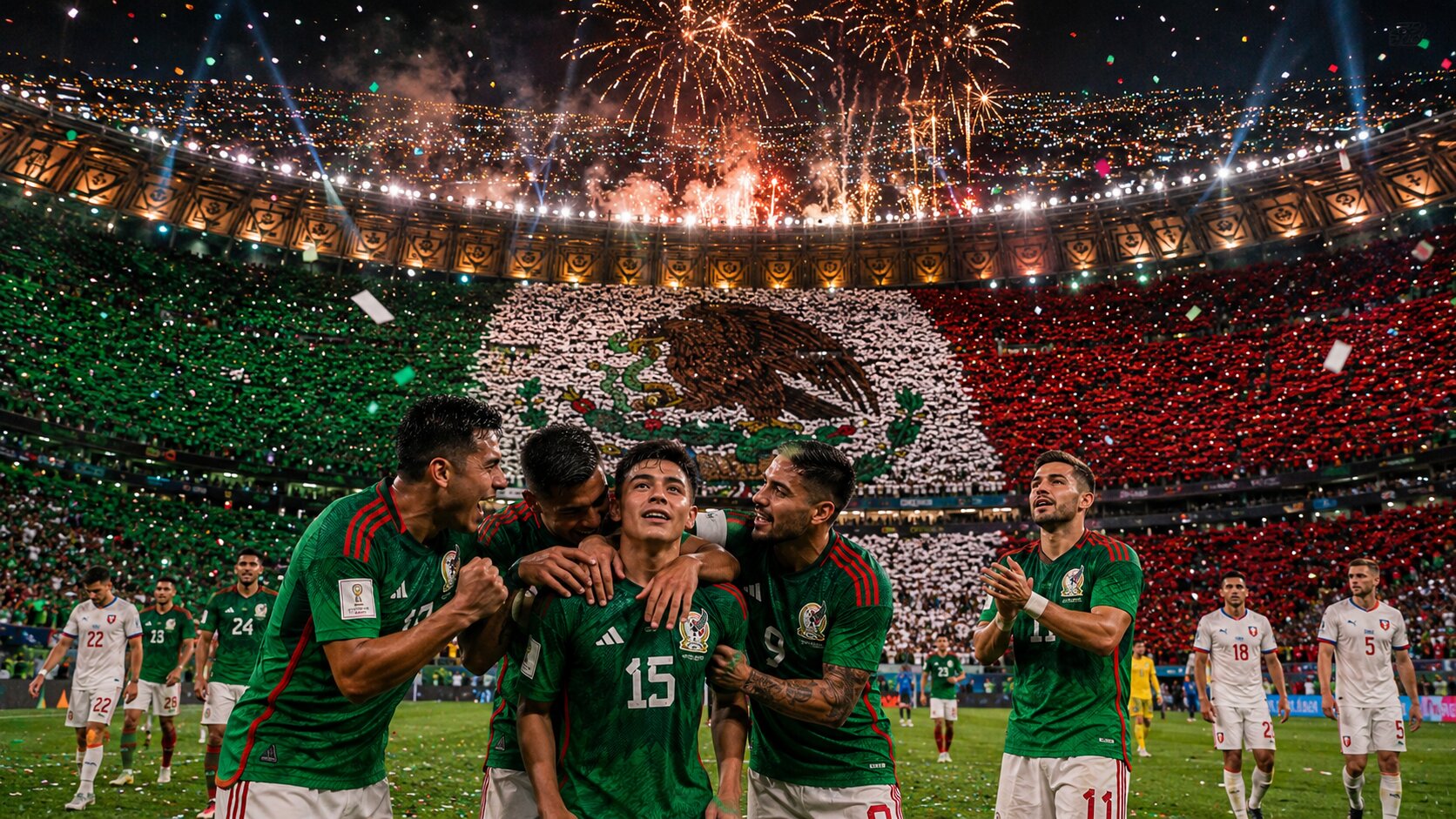
Mexico 3-0 Czechia produces Mexico’s best performance in the 2026 World Cup.
Sometimes a Victory Means Much More Than Three Points
There are nights that become part of football history.
Not because they deliver an unforgettable goal.
Not because they produce a dramatic comeback.
But because they signal the arrival of something much bigger.
Mexico’s commanding 3-0 victory over Czechia at the legendary Estadio Azteca was one of those nights.
When referee Anthony Taylor blew the final whistle, more than 83,000 supporters inside the stadium erupted into celebration. Thousands embraced complete strangers. Green, white and red flags waved throughout the stands. The famous “Cielito Lindo” echoed through Mexico City long after the players had disappeared into the tunnel.
Across the country, millions more celebrated in homes, restaurants, plazas, and official FIFA Fan Festivals.
For Mexico, this was far more than another group-stage victory.
It completed a perfect first round.
Three matches.
Three victories.
Nine points.
A 6-0 goal difference.
Group winners.
No goals conceded.
Perhaps even more importantly, Mexico demonstrated that it possesses something every World Cup contender needs: the ability to improve as the tournament progresses.
Against South Africa, El Tri looked composed.
Against South Korea, they looked resilient.
Against Czechia, they looked dominant.
For a nation that has spent decades dreaming of reaching the elusive “quinto partido” and beyond, hope suddenly feels more realistic than it has in many years.
A Historic Night at the Azteca
Few stadiums in football possess the emotional weight of the Estadio Azteca.
Pelé became immortal there.
Maradona created history there.
Generations of Mexican supporters have experienced unforgettable triumphs and heartbreaking disappointments beneath its towering stands.
Now another memorable chapter has been added.
The atmosphere before kickoff was extraordinary.
Hours before the match, supporters filled the streets surrounding the stadium wearing green jerseys, waving enormous Mexican flags, singing traditional football chants, and believing that this team might finally be capable of something special.
When the players emerged from the tunnel, an enormous supporter mosaic covered much of the stadium.
The noise was deafening.
The pressure was enormous.
Mexico embraced both.
Rather than appearing nervous, Javier Aguirre’s team immediately took control of the match, playing with confidence, intelligence, and remarkable composure.
From the opening whistle, Czechia found itself chasing shadows.
Mexico Controlled Every Phase of the Match
The scoreline tells only part of the story.
Mexico did not simply defeat Czechia.
They controlled nearly every aspect of the contest.
Possession remained patient but purposeful.
The midfield dictated the tempo.
Defensively, El Tri rarely allowed Czechia to establish sustained pressure.
The pressing was coordinated.
The passing combinations were sharp.
The movement off the ball constantly forced Czech defenders into uncomfortable positions.
Perhaps most impressive was Mexico’s emotional discipline.
The players never became rushed despite the enormous expectations surrounding the match.
Every attack appeared carefully constructed.
Every defensive recovery happened with urgency.
It was one of Mexico’s most complete World Cup performances in decades.
Mexico 3-0 Czechia Video with Goals and Highlights
Gilberto Mora Announces Himself to the World
Every World Cup introduces new stars.
Some emerge unexpectedly.
Others fulfill expectations.
Against Czechia, Gilberto Mora delivered the type of performance that could define an international career.
The young midfielder played with extraordinary maturity despite the enormous pressure of performing before a home crowd.
What immediately stood out was his confidence.
He demanded possession.
He attacked defenders without hesitation.
He constantly searched for creative passing angles.
Whenever Mexico accelerated the pace, Mora seemed to be at the center of the move.
His technical ability has never been questioned.
Against Czechia, he demonstrated something equally important: decision-making.
Too often, young players attempt spectacular plays when simple football would suffice.
Mora consistently chose the correct option.
When space opened, he attacked.
When teammates were better positioned, he passed.
When Czechia pressed aggressively, he remained calm.
His composure transformed Mexico’s midfield into the engine of the entire performance.
If this tournament continues along its current path, World Cup 2026 may ultimately be remembered as the competition that introduced Gilberto Mora to football supporters around the globe.
Mexico’s 17 Year Old Gilberto Mora: An Emerging Superstar?
Why Mora’s Performance Was So Important
The significance of Mora’s display extends well beyond one match.
For years, Mexico has searched for the next great creative midfielder capable of controlling games against elite opposition.
Against Czechia, Mora suggested he might become that player.
His intelligence between the lines repeatedly disrupted Czechia’s defensive organization.
He connected defense to attack with remarkable efficiency.
Most importantly, he played fearlessly.
That mentality cannot be taught.
The world’s greatest footballers embrace pressure rather than avoiding it.
At the Azteca, surrounded by millions of expectations, Mora looked completely at home.
That should excite every Mexican supporter.
Edson Álvarez: The Silent Leader
While attacking players naturally receive most of the headlines, Edson Álvarez once again reminded supporters why he remains indispensable.
His positioning shielded the defense.
His leadership organized the midfield.
His physical presence prevented Czechia from establishing rhythm.
Championship teams require players willing to perform the less glamorous tasks.
Álvarez embraces those responsibilities.
Throughout the tournament, he has become the team’s emotional anchor.
His consistency allows creative players greater freedom.
That balance may become one of Mexico’s greatest strengths during the knockout stage.
Mexico’s Defense Has Become One of the Tournament’s Best
Scoring six goals through three matches is impressive.
Conceding none may be even more remarkable.
Mexico’s defensive organization has quietly become one of the tournament’s defining success stories.
The back line communicates exceptionally well.
The fullbacks recover quickly.
The midfield consistently provides defensive support.
Goalkeeper Luis Ángel Malagón has inspired confidence whenever called upon.
Championship teams are rarely built solely through attacking brilliance.
They are built through balance.
Mexico increasingly looks like a balanced team.
That should concern every potential knockout-stage opponent.
A Nation Celebrates Together
As the final whistle echoed through the Azteca, celebrations spread far beyond Mexico City.
The official FIFA Fan Festival in the capital erupted into chants, fireworks, music, and spontaneous celebrations that continued late into the evening.
Families embraced while watching giant public screens.
Children wearing Mexico jerseys danced with strangers.
Veteran supporters who had followed El Tri through decades of triumph and disappointment celebrated with visible emotion.
Similar scenes unfolded in Guadalajara, Monterrey, Puebla, Mérida, Tijuana, León, and countless smaller cities.
Restaurants overflowed with supporters.
Public plazas became seas of green.
Caravans filled streets with flags, horns, and singing.
Social media exploded with images of packed Fan Festivals, emotional supporters, and celebrations extending well into the night.
For one evening, football united an entire nation.
That emotional connection is one of the greatest advantages any host nation can possess.
Mexican Fan Reactions as they Celebrate 3-0 Victory
Javier Aguirre’s Blueprint Is Becoming Clear
Every successful World Cup campaign develops an identity.
Argentina won in 2022 through resilience and collective belief.
Spain’s golden generation mastered possession.
Germany’s 2014 champions combined relentless pressing with tactical flexibility.
Three matches into World Cup 2026, Mexico is beginning to establish its own identity.
Javier Aguirre has built a team that is disciplined without sacrificing creativity, aggressive without becoming reckless, and patient without losing attacking ambition.
One of the most noticeable changes has been Mexico’s ability to adapt during matches.
Against South Africa, El Tri controlled possession and waited patiently for opportunities.
Against South Korea, they demonstrated defensive maturity and emotional resilience.
Against Czechia, they dominated from beginning to end, pressing high, moving the ball quickly, and attacking with confidence.
That tactical flexibility could become invaluable during the knockout rounds.
Every opponent presents different challenges.
Mexico now appears capable of adjusting without abandoning its footballing philosophy.
Perhaps even more encouraging is the chemistry throughout the squad.
Players celebrate one another’s success.
Veterans encourage younger teammates.
Substitutes enter matches with energy and purpose.
That unity is often the hidden ingredient behind deep World Cup runs.
The Azteca Once Again Became Mexico’s Greatest Ally
There are stadiums.
And then there is the Azteca.
Throughout football history, few venues have produced an atmosphere capable of influencing matches as consistently as Mexico City’s legendary cathedral of football.
Against Czechia, that atmosphere reached extraordinary levels.
Every successful tackle generated thunderous applause.
Every Mexican attack produced a wave of anticipation.
Every Czech mistake was met with deafening noise.
From the opening anthem until the final whistle, the supporters never stopped singing.
The famous chant of “¡México! ¡México! ¡México!” echoed continuously throughout the evening.
When Gilberto Mora produced moments of brilliance, the stadium erupted.
When Santiago Giménez pressed defenders, supporters responded with renewed energy.
When the third goal finally arrived, the celebration felt less like a football match and more like a national holiday.
Visiting teams often speak about the challenge of playing at altitude in Mexico City.
Against Czechia, another factor became equally significant.
The crowd itself.
It is impossible to measure statistically.
Yet every footballer understands the emotional lift created by eighty thousand passionate supporters believing every tackle, every pass, and every attack can change history.
Mexico clearly fed off that energy.
Fan Festivals Across Mexico Became Massive Celebrations
The celebrations extended far beyond the Azteca.
Official FIFA Fan Festivals in Mexico City became enormous gatherings hours before kickoff.
By the time the match began, thousands of supporters filled public viewing areas dressed almost entirely in green.
Every goal triggered an explosion of emotion.
Confetti filled the air.
Traditional mariachi music mixed with football chants.
Families embraced complete strangers.
Children waved enormous Mexican flags while older supporters reflected on decades of following El Tri through moments of triumph and disappointment.
In Guadalajara, Monterrey, Puebla, Mérida, Tijuana, León, Querétaro, Toluca, and dozens of other cities, similar scenes unfolded.
Restaurants overflowed with fans.
Public squares became seas of green, white, and red.
Car horns echoed through city streets long after the final whistle.
Television broadcasts captured remarkable scenes of celebration stretching from northern border communities to the Yucatán Peninsula.
Social media quickly filled with videos of supporters singing “Cielito Lindo,” dancing in public plazas, and celebrating what many described as one of Mexico’s finest World Cup performances in modern history.
For one unforgettable evening, football united the country.
Mexico’s Perfect Group Stage Changes the Entire Tournament
Winning three matches is impressive.
Winning all three while conceding no goals sends an even stronger message.
Mexico now enters the knockout stage carrying confidence that few teams possess.
Momentum can become one of the most valuable assets in tournament football.
Players begin believing they can defeat anyone.
Supporters begin dreaming bigger.
Opponents begin paying closer attention.
Mexico has earned all three.
Just as importantly, El Tri has avoided the emotional roller coaster experienced by several traditional powers during the group stage.
There has been steady improvement with each performance.
That progression suggests Mexico’s best football may still lie ahead.
For a host nation, that possibility is incredibly exciting.
Who Could Await Mexico in the Knockout Stage?
Finishing first in the group dramatically changes Mexico’s path through the tournament.
Rather than immediately facing another group winner, El Tri will likely meet one of the strongest runners-up from another group.
Potential opponents could include established European powers that stumbled during the group stage, emerging African contenders, or dangerous South American sides that narrowly missed first place.
Regardless of the opponent, one thing has become clear.
No team will look forward to facing Mexico.
The combination of confidence, tactical discipline, defensive solidity, and overwhelming crowd support makes El Tri one of the most dangerous teams remaining.
Should Mexico continue advancing, possible later-round opponents could include traditional giants such as Brazil, France, England, Spain, Argentina, or Portugal.
Those matches would naturally present enormous challenges.
Yet after watching Mexico dominate its group, few observers would dismiss the possibility of another surprise.
That alone represents a remarkable transformation from expectations before the tournament began.
Can This Team Finally Break Mexico’s Historic Barrier?
For generations, one question has followed Mexican football.
Can El Tri finally move beyond the Round of 16?
The so-called “quinto partido” has become one of the defining ambitions of modern Mexican football.
This team appears uniquely positioned to pursue it.
The reasons extend beyond talent.
The defense has been exceptional.
The midfield controls matches.
Young players have embraced responsibility.
Experienced veterans have provided calm leadership.
The coaching staff has shown tactical flexibility.
Most importantly, the players genuinely believe.
World Cups are often won as much through confidence as technical ability.
Mexico currently possesses both.
No one is suggesting the road ahead will be easy.
The knockout rounds become progressively more difficult.
Every mistake carries enormous consequences.
Every match can end a dream.
Yet for the first time in many years, Mexico enters that stage not merely hoping to survive.
The team enters believing it can compete with the world’s best.
That psychological shift may prove just as important as any tactical adjustment.
Final Thoughts
Mexico’s 3-0 victory over Czechia was about much more than securing first place.
It represented the culmination of an outstanding group-stage campaign built upon discipline, attacking quality, defensive excellence, and unwavering belief.
Gilberto Mora announced himself as one of the tournament’s brightest young stars.
Santiago Giménez continued demonstrating why he has become the focal point of Mexico’s attack.
Edson Álvarez once again provided the leadership that championship teams require.
Behind them stood an inspired defense that has yet to concede a goal.
Beyond the pitch, millions of supporters transformed stadiums, Fan Festivals, city streets, and homes into unforgettable celebrations of national pride.
The entire country now shares a common dream.
Mexico has completed a perfect group stage.
The knockout rounds await.
The opposition will become stronger.
The pressure will become greater.
But after three commanding victories, one question is echoing throughout Mexico and increasingly around the football world:
Could this finally be the World Cup where El Tri makes history?
Keep reading more World Cup coverage in our website: TheWorldCup2026.com


