
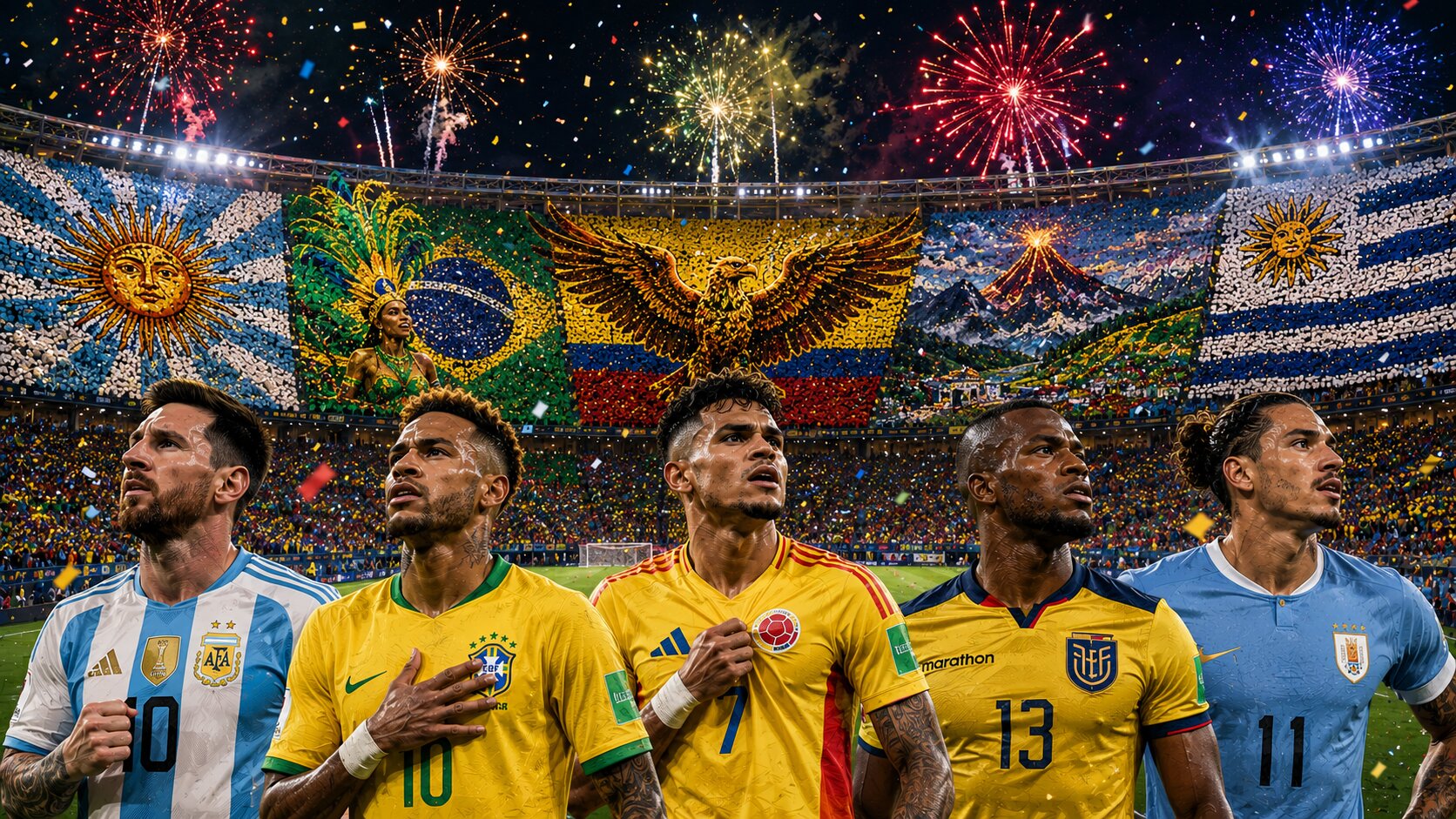
South American Nations World Cup 2026 Analysis of the groups stage perfomances. Who shines and who has failed?
South America Once Again Proves Why It Remains Football’s Most Passionate Continent
Every World Cup tells a story.
Some stories are about giants defending their reputations.
Others are about underdogs chasing history.
For South America, World Cup 2026 has been a little of both.
As the group stage concluded and the knockout phase began, the nations of CONMEBOL once again demonstrated why they remain among the most respected football powers on earth. Despite representing a continent of only twelve sovereign nations, South America continues to produce an extraordinary number of elite football teams capable of competing with anyone.
This year’s tournament has reinforced that reputation.
Argentina has looked increasingly dangerous.
Brazil has grown stronger with each match.
Colombia has emerged as one of the tournament’s most balanced teams.
Ecuador produced one of the biggest surprises of the group stage.
Meanwhile, Uruguay suffered one of the most disappointing exits of any traditional football power.
The story of South America at World Cup 2026 is ultimately a story of ambition, quality, and the relentless pursuit of football greatness.
Argentina: The Defending Champions Still Look Dangerous
If there was any doubt that Argentina remained among the favorites to win the World Cup, the group stage largely erased it.
The reigning world champions approached the tournament with confidence and maturity.
Perhaps most impressively, Argentina demonstrated something many championship teams struggle to achieve: balance between experienced veterans and emerging talent.
Lionel Messi remains the emotional leader of the squad.
Even at this stage of his extraordinary career, he continues to influence matches in decisive moments.
His stunning free-kick goal against Jordan after entering as a substitute was one of the iconic moments of the group stage and reminded the world that football’s greatest magician still possesses game-changing brilliance.
However, Argentina is no longer dependent upon Messi alone.
The supporting cast has been exceptional.
The midfield remains organized and intelligent.
The defense has shown consistency.
The attack continues creating opportunities from multiple sources.
The result is a team that appears capable of making another deep run.
Argentina enters the knockout stage against Cape Verde as one of the strongest contenders to reach the semifinals and perhaps even the final.
Brazil Is Beginning to Look Like Brazil Again
Few teams generated more discussion during the group stage than Brazil.
The Seleção entered the tournament carrying enormous expectations, as always.
At times, those expectations can become a burden.
Yet Brazil’s performances suggest that this team is growing stronger precisely when it matters most.
The defining moment came in the convincing 3-0 victory over Scotland.
That match showcased many of the qualities that have historically made Brazil one of football’s most feared nations.
Creativity.
Confidence.
Technical excellence.
Attacking flair.
The performance demonstrated that Brazil possesses multiple ways to win matches.
When the attack is flowing, few teams can match its firepower.
When the match becomes physical or tactical, Brazil has shown increasing maturity.
Perhaps most importantly, several younger players appear increasingly comfortable carrying responsibility on football’s biggest stage.
Brazil still has areas to improve.
Defensive concentration occasionally remains a concern.
Finishing consistency can fluctuate.
Yet few teams possess a higher ceiling.
If Brazil continues improving, it could become one of the most dangerous teams in the knockout stage.
Colombia: The Tournament’s Most Underrated Contender
No South American nation may have exceeded expectations more than Colombia.
While global attention has largely focused on Argentina, Brazil, France, and Spain, Colombia quietly assembled one of the most impressive group-stage campaigns of the tournament.
The Colombians finished first in a difficult group that included Portugal.
That achievement alone deserves enormous recognition.
The reason for Colombia’s success is relatively simple.
Balance.
Few teams in the tournament appear as complete.
Defensively, Colombia remains organized.
In midfield, the team controls tempo effectively.
In attack, the squad possesses genuine match-winning talent.
Luis Díaz has been particularly impressive.
His pace, creativity, and willingness to challenge defenders have made him one of the tournament’s standout performers.
Perhaps even more impressive was Colombia’s thrilling 0-0 draw against Portugal.
The scoreline suggested a defensive struggle.
The reality was one of the most entertaining matches of the World Cup.
The performance demonstrated that Colombia can compete with elite opposition.
That lesson could prove significant as the knockout stage unfolds.
Many observers continue overlooking Colombia.
That may be a mistake.
Ecuador Delivers One of the Biggest Surprises
Every World Cup produces unexpected heroes.
For South America, Ecuador has become one of them.
The Ecuadorians produced one of the most shocking results of the group stage by defeating Germany.
That victory immediately elevated Ecuador’s reputation throughout the tournament.
More importantly, it demonstrated a growing confidence within the program.
For years, Ecuador has produced talented players.
What has sometimes been missing is consistency against elite opponents.
World Cup 2026 suggests that gap may be closing.
The victory against Germany revealed a team willing to play aggressively rather than simply survive.
The players demonstrated courage.
The coaching staff showed tactical intelligence.
The supporters received proof that Ecuador can compete with football’s traditional powers.
Whether Ecuador can sustain that momentum remains uncertain.
Yet the group stage established the nation as one of the most intriguing teams remaining in the tournament.
Uruguay: The Great South American Disappointment
Not every South American story has been positive.
Uruguay’s campaign ranks among the biggest disappointments of World Cup 2026.
Entering the tournament, expectations were significant.
The squad possessed experience.
The squad possessed talent.
The squad possessed a proud football tradition.
Unfortunately, the performances rarely matched those expectations.
The final blow came in the 1-0 defeat against Spain.
Although the scoreline was narrow, Uruguay struggled to consistently impose its style upon the match.
Even more concerning was the growing frustration displayed by several players.
The team’s disciplinary problems became a major talking point.
Many observers criticized the physical nature of Uruguay’s approach and argued that the squad allowed emotions to override tactical discipline.
The late red card symbolized a campaign that increasingly unraveled under pressure.
The tournament also reignited questions regarding veteran goalkeeper Fernando Muslera.
Several costly mistakes contributed to criticism of his performances.
While it would be unfair to place responsibility entirely upon one player, Uruguay’s defensive stability often appeared fragile.
For a nation with such a rich football history, a group-stage elimination represents a major disappointment.
The Outstanding South American Players
Several South American stars have elevated their reputations during World Cup 2026.
Lionel Messi (Argentina)
The legendary Argentine continues writing football history.
Even in limited minutes, Messi remains capable of producing moments that alter entire tournaments.
His free-kick against Jordan became one of the iconic images of the group stage.
Luis Díaz (Colombia)
Perhaps the most influential South American player outside Argentina and Brazil.
His performances have helped transform Colombia into a legitimate contender.
Vinícius Júnior (Brazil)
Brazil’s attacking star continues demonstrating why he is considered one of the world’s elite footballers.
His speed and creativity remain devastating.
Gilberto Mora (Mexico’s breakout star)
Although not South American, his emergence became one of the defining stories involving Latin American football during the tournament.
Ecuador’s Emerging Generation
The Ecuadorians may not possess a single global superstar, but several players announced themselves to international audiences through fearless performances against elite opposition.
Video South American Nations World Cup 2026
What Have We Learned About South American Football?
World Cup 2026 reinforces several important conclusions.
First, South America remains football’s most efficient producer of elite national teams.
The continent has relatively few countries.
Yet multiple South American nations consistently compete among the world’s best.
Second, tactical sophistication continues increasing.
The stereotype of South American football as purely emotional or attacking no longer applies.
Argentina, Colombia, and Ecuador have all demonstrated impressive tactical organization.
Third, depth is growing.
Historically, South American hopes often rested almost entirely on Argentina and Brazil.
Today, Colombia and Ecuador are increasingly capable of challenging elite opponents.
That broader competitiveness strengthens the entire region.
Comparing 2026 With Previous World Cups
Compared with recent tournaments, South America’s performance has been exceptionally strong.
Argentina looks capable of defending its title.
Brazil appears increasingly dangerous.
Colombia has emerged as a serious contender.
Ecuador has surprised the football world.
Only Uruguay significantly underperformed expectations.
The overall balance is encouraging.
Rather than relying on one dominant nation, South America enters the knockout stage with multiple teams capable of reaching the later rounds.
That diversity represents a major strength.
Looking Ahead
The knockout stage will determine whether South America’s impressive group-stage performances can translate into genuine championship challenges.
Argentina appears ready.
Brazil appears dangerous.
Colombia appears underestimated.
Ecuador appears fearless.
Together, they represent one of the strongest continental contingents remaining in the tournament.
If current trends continue, it would not be surprising to see multiple South American teams reach the quarterfinals or semifinals.
And if one of them ultimately lifts the trophy, few observers would be shocked.
Final Thoughts
South America leaves the group stage with reasons for optimism.
Argentina continues its pursuit of back-to-back world titles.
Brazil appears to be finding its rhythm.
Colombia has become a legitimate contender.
Ecuador has emerged as one of the tournament’s great surprises.
Uruguay leaves disappointed, but even that disappointment reflects the extraordinarily high standards expected of South American football.
The continent remains one of the great powers of the sport.
World Cup 2026 has only reinforced that reality.
As the knockout stage begins, South America is not merely participating.
It is competing to win.
And judging by what we have seen so far, several South American nations possess a realistic chance of doing exactly that.
Lots more to find about international footbal and the World Cup in TheWorldCup2026.com


