
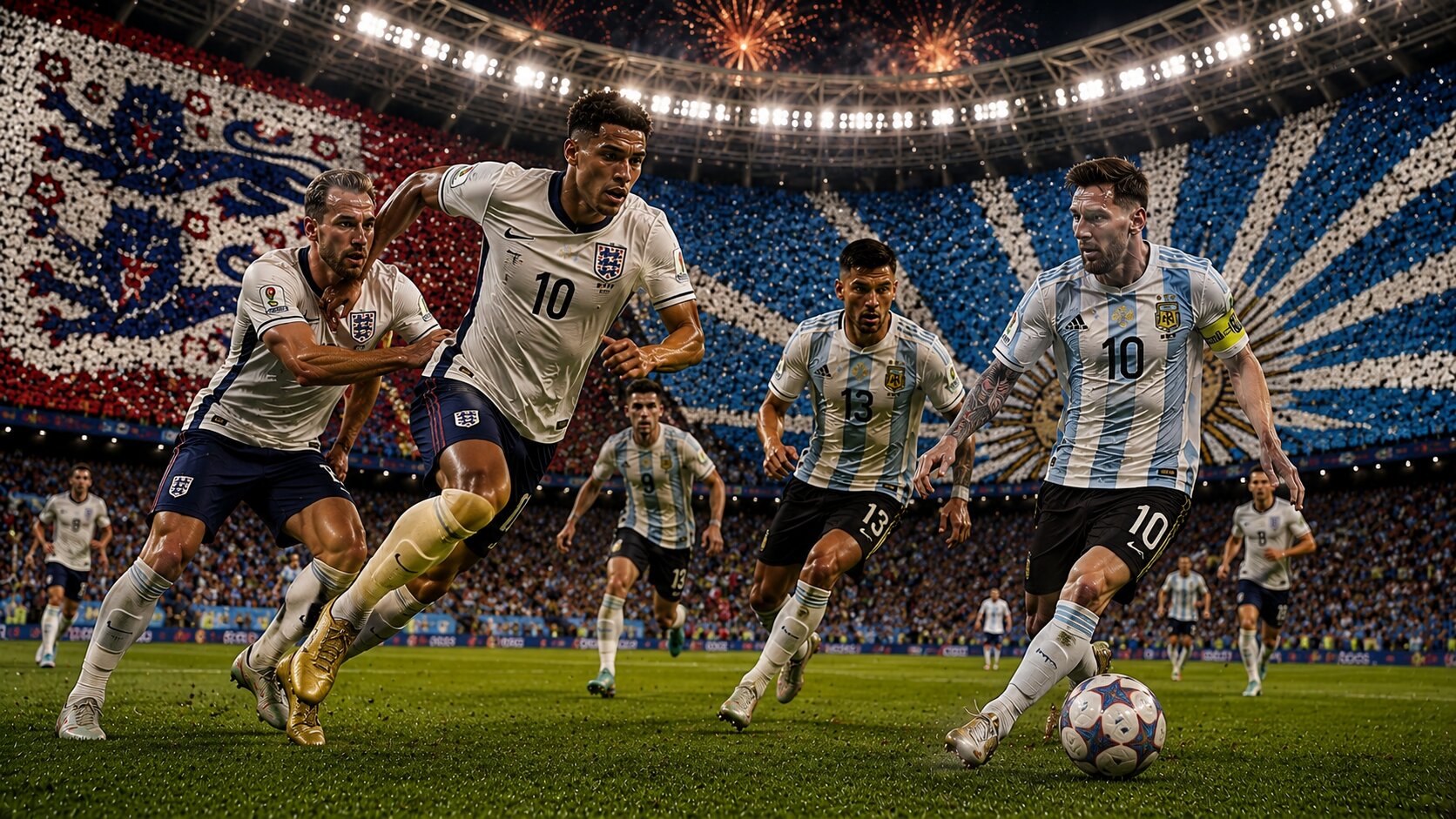
England vs Argentina World Cup 2026 Semifinal Preview: A World Cup Rivalry Returns With a Place in the 2026 Final at Stake
England and Argentina will renew one of international football’s most emotionally charged rivalries in the semifinals of the 2026 FIFA World Cup.
The match is scheduled for Wednesday, July 15, at Atlanta Stadium, with the winner advancing to the final against France or Spain. Argentina arrives as the defending world champion and is attempting to become the first nation since Brazil in 1962 to retain the trophy. England is pursuing its first World Cup title since 1966 after reaching another major-tournament semifinal under Thomas Tuchel.
This is not merely a meeting between two talented teams. England against Argentina carries decades of history: disputed refereeing decisions, dismissals, penalty shootouts, political tension, iconic goals and unforgettable individual performances.
Now Lionel Messi, Jude Bellingham, Harry Kane and Julián Álvarez will add a new chapter.
Video England vs Argentina World Cup 2026 Preview and Results from Recent Matches
Why England vs Argentina Matters So Much
England and Argentina had met five times at the men’s World Cup before this tournament, with England winning three and Argentina winning two. Yet the importance of the rivalry cannot be measured by the overall record alone. Almost every meeting has produced an incident remembered long after the final whistle.
The 1966 quarterfinal at Wembley was among the most controversial. England won 1-0 after Argentina captain Antonio Rattín was sent off in a match filled with hostility and confusion. Rattín’s dismissal—and the communication problems surrounding it—helped inspire the later introduction of yellow and red cards as a clearer international system of discipline.
Twenty years later came the most famous match in the rivalry. Diego Maradona scored both goals in Argentina’s 2-1 quarterfinal victory in Mexico City. The first became known as the “Hand of God.” The second, an extraordinary solo run through England’s defense, was later voted the World Cup’s Goal of the Century. Argentina went on to win the tournament.
In 1998, Argentina advanced on penalties following a 2-2 draw in a match remembered for Michael Owen’s brilliant goal, Javier Zanetti’s clever equalizer and David Beckham’s red card after his confrontation with Diego Simeone.
Beckham earned a measure of redemption in 2002, scoring the penalty that gave England a 1-0 group-stage victory. That remains the most recent World Cup meeting between the two senior teams.
The 2026 semifinal therefore arrives with an extraordinary historical burden. Every decision will be examined. Every physical confrontation will be interpreted through the memory of previous matches. The players must manage the emotional weight without allowing it to destroy their tactical discipline.
England’s Road to the Semifinals
England opened its campaign with an exciting 4-2 victory over Croatia. Harry Kane scored twice, while Jude Bellingham and Marcus Rashford also found the net. The performance showed England’s attacking potential, but the team became less convincing during the remainder of the group stage. A scoreless draw against Ghana and a labored victory over Panama raised questions about imagination, tempo and England’s dependence on its two biggest stars.
England defeated the Democratic Republic of Congo 2-1 in the Round of 32 before surviving a remarkable Round of 16 encounter against Mexico at Estadio Azteca.
The Three Lions beat Mexico 3-2 despite playing much of the second half with ten men following Jarell Quansah’s dismissal. Bellingham scored twice, Kane converted a penalty and goalkeeper Jordan Pickford made important late saves as England resisted intense pressure from the host nation.
The quarterfinal against Norway again exposed England’s weaknesses while confirming its resilience. Andreas Schjelderup gave Norway the lead, but Bellingham equalized before halftime and scored the winner in extra time. Norway threatened repeatedly, and Tuchel admitted afterward that England’s overall performance had not been good enough despite the team’s determination and unity.
England has therefore reached the semifinal without consistently controlling knockout matches. Its greatest strength has been survival: adapting to hostile crowds, red cards, extra time and periods in which the opponent has played better.
That mentality matters. But against Argentina, England may need more than courage.
Argentina’s Path Through the Tournament
Argentina’s group-stage campaign was more authoritative.
The defending champions defeated Algeria 3-0 and Austria 2-0 to secure first place in Group J with a match remaining. Messi scored all five Argentine goals across those first two games, including both against Austria as he surpassed Miroslav Klose’s men’s World Cup scoring record. Argentina then beat Jordan 3-1 after rotating its lineup, with Messi coming off the bench and scoring from a free kick.
The knockout rounds have been much less comfortable.
Argentina needed extra time to defeat World Cup newcomer Cabo Verde 3-2 in the Round of 32. It then survived an extraordinary Round of 16 match against Egypt, overturning a two-goal deficit and winning 3-2 with three late goals. Messi scored and assisted Cristian Romero during the comeback.
Switzerland pushed Argentina into another extra-time battle in the quarterfinal. Alexis Mac Allister headed in Messi’s corner, but Dan Ndoye equalized in the second half. Switzerland was reduced to ten men following Breel Embolo’s controversial second yellow card, and Argentina eventually broke through when Julián Álvarez scored from long range in the 112th minute. Lautaro Martínez added the final goal in a 3-1 victory.
Argentina is unbeaten in 12 consecutive World Cup matches and remains capable of producing decisive moments when exhausted, frustrated or apparently close to elimination. However, the defending champions have also conceded six goals across their three knockout games and have required extra time twice.
Their resilience is unquestionable. Their defensive security is not.
Lionel Messi: Still Argentina’s Central Figure
Messi remains the player around whom Argentina’s attacking structure is built.
At 39, he has scored eight goals at the tournament and entered the quarterfinal level with Kylian Mbappé in the Golden Boot race. Scaloni has described him as a “machine,” emphasizing that his longevity is the product of preparation as well as exceptional natural ability.
Messi does not need to dominate possession to decide a match. He can drop into midfield, attract two defenders and release a runner. He can create from a set piece, as he did for Mac Allister against Switzerland. He can also slow the match when Argentina needs control.
England’s challenge will not simply be stopping Messi from shooting. It must prevent him from receiving the ball facing forward between midfield and defense.
Rice is likely to have an important screening role, while England’s central defenders must resist the temptation to leave their positions whenever Messi drops deep. If one defender follows him, Álvarez or Lautaro can attack the abandoned space.
Bellingham and Kane Carry England’s Attack
England has become heavily dependent on Bellingham and Kane.
After the Norway quarterfinal, the pair had scored 12 of England’s 13 tournament goals. Tuchel praised their decisive contributions but acknowledged that England needs more attacking players to become involved.
Bellingham has been England’s defining knockout-stage performer. His two goals against Mexico were followed by another two against Norway. At 23, he has combined scoring, ball carrying, pressing and emotional leadership, while his six tournament goals equal Kane’s total.
His late arrivals into the penalty area may be England’s best weapon against Argentina. Argentine midfielders must decide whether to press England’s buildup or track Bellingham when he moves beyond Kane. If they lose sight of him, he can attack the space between Cristian Romero and the fullbacks.
Kane remains equally important even when he does not score. His ability to drop toward midfield can draw a central defender away and create room for Bellingham, Bukayo Saka or another wide attacker.
Argentina’s center backs will be comfortable with physical confrontation. They may be less comfortable if Kane repeatedly leaves the central zone and forces them to make decisions about whether to follow.
The Tactical Question for Thomas Tuchel
Tuchel’s central decision will concern England’s level of aggression.
A high defensive line could compress the field and prevent Argentina from establishing possession. It could also leave dangerous space for Álvarez and other runners.
A deeper block would protect England against those runs but could allow Messi too much room outside the penalty area.
England may therefore adopt a selective press rather than applying constant pressure. Kane could direct Argentina’s buildup toward one side, with Bellingham and the wide attackers jumping forward only when a clear pressing trigger appears.
In possession, England must move the ball faster than it did against Norway. Tuchel publicly said the team needed better football after that quarterfinal, not simply another display of character.
Saka’s availability and influence could be crucial. Before the tournament, Reuters identified Kane, Bellingham and Saka as the attacking core capable of matching any opponent. Saka’s width would force Argentina’s left side to defend honestly and reduce its freedom to support Messi.
Scaloni’s Likely Plan
Lionel Scaloni used a four-player midfield behind Messi and Álvarez against Switzerland, with Leandro Paredes, Rodrigo De Paul, Enzo Fernández and Mac Allister offering control, aggression and passing quality.
A similar structure would make sense against England.
De Paul can pressure England’s ball carriers and provide defensive support around Messi. Mac Allister and Fernández can move possession through midfield, while Paredes can protect the central defenders and distribute from deep.
Scaloni must also decide how aggressively his fullbacks should advance. England has been dangerous in transition, particularly when Bellingham carries the ball through midfield. If both Argentine fullbacks attack simultaneously, Kane and Bellingham could exploit the open spaces behind them.
Argentina may instead prioritize control, keep one fullback deeper and attempt to force England into a patient positional game. England has looked less convincing when opponents deny transitions and ask it to create against an organized defense.
Where the Match Could Be Won
The first major battle will be between Rice and Messi’s zone. Rice cannot follow Messi everywhere, but he must reduce the quality and frequency of passes reaching him.
The second will involve Bellingham against Argentina’s midfield. England needs Bellingham near the penalty area, but Argentina will try to drag him backward through extended possession.
The third is discipline.
England and Argentina have both experienced controversial dismissals and video-review decisions during the knockout stage. Given the history between these countries, emotional control will be essential. A reckless challenge or act of retaliation could transform the semifinal.
Set pieces may also matter. Argentina scored from a Messi corner against Switzerland, while England possesses Kane, Bellingham and several powerful defenders capable of attacking crosses.
Prediction: Argentina’s Experience Against England’s Energy
The semifinal is exceptionally difficult to predict.
Tournament futures cited by the Associated Press before the semifinal stage placed England at +330 and Argentina at +360, suggesting that the broader championship market regarded the two teams as closely matched, although France remained the leading favorite.
England is younger, more physical and potentially more explosive through midfield. Bellingham is in extraordinary form, Kane remains a proven scorer, and England has demonstrated that it can survive chaotic matches.
Argentina possesses greater recent championship experience, a more settled tactical identity and the greatest creative player of his generation. Its unbeaten World Cup run and repeated ability to escape difficult situations cannot be dismissed.
The major concern for England is its dependence on Kane and Bellingham. The major concern for Argentina is a defense that has repeatedly conceded in the knockout phase.
This match is likely to be cautious initially, then increasingly open after halftime. Both sides have enough attacking quality to score, but neither has consistently controlled the full 90 minutes during the knockout rounds.
Predicted result: Argentina 2-1 England after extra time.
Argentina’s experience, midfield control and capacity to produce decisive late moments give it a very narrow advantage. Yet England is fully capable of reversing that prediction if Bellingham again dominates the spaces around the penalty area and Tuchel succeeds in limiting Messi’s influence.
Whatever the result, the 2026 semifinal will not be viewed as an ordinary match. It will join 1966, 1986, 1998 and 2002 in the long and dramatic history of England against Argentina—two football nations whose World Cup meetings rarely pass quietly.
Stay on top with TheWorldCup2026.com!


