
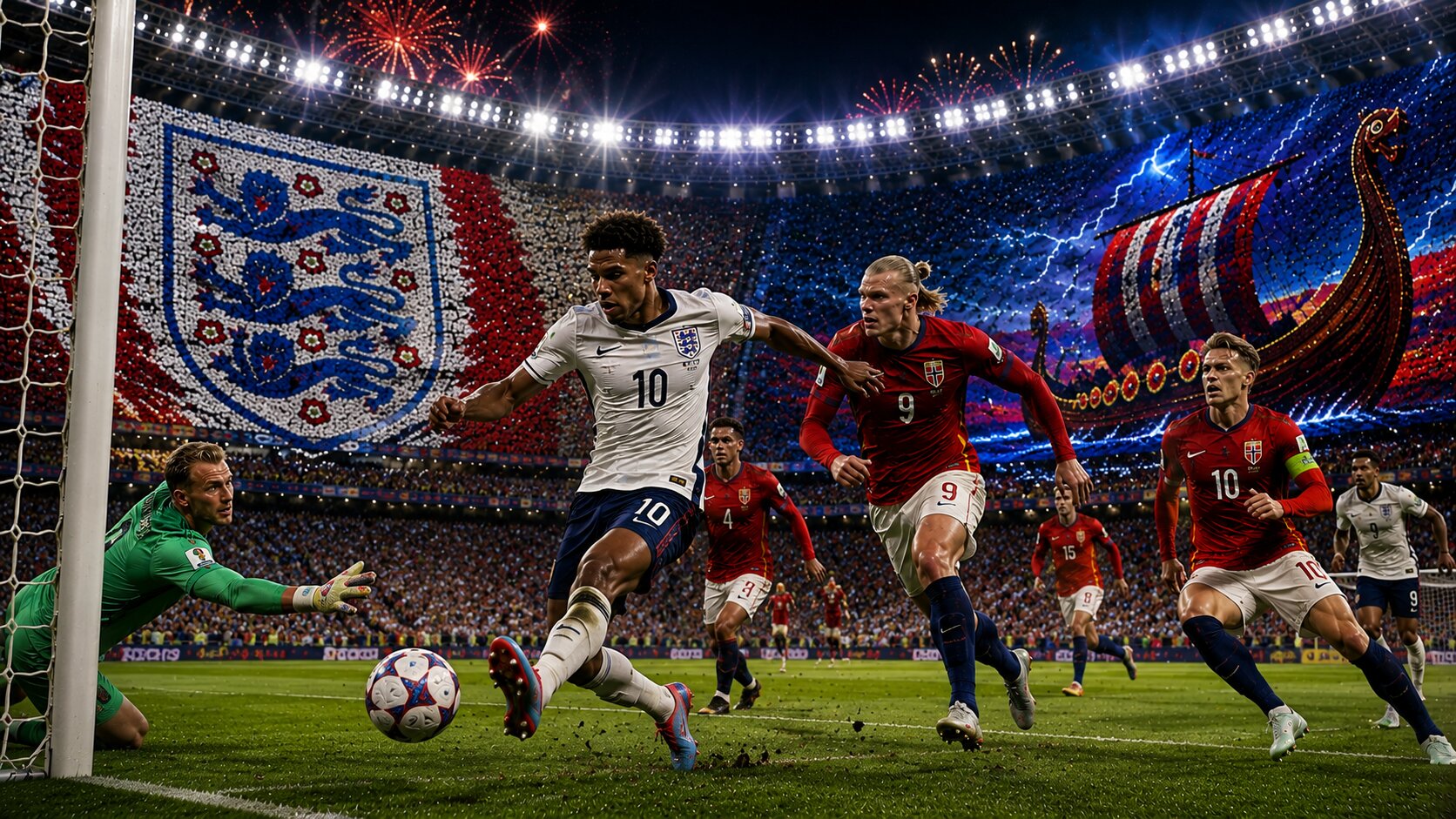
England 2-1 Norway World Cup 2026: Bellingham Scores Twice as Three Lions Reach World Cup 2026 Semifinal
England is through to the semifinals of the 2026 FIFA World Cup, but its 2-1 extra-time victory over Norway was far more difficult, controversial and exhausting than the final result alone suggests.
Norway took the lead through Andreas Schjelderup in the 36th minute and came close to scoring again on several occasions. England survived those threats before Jude Bellingham emerged as the decisive figure, scoring the equalizer shortly before halftime and then delivering the winning goal only three minutes into extra time.
The victory sends England into a historic semifinal against Argentina. Norway leaves the tournament after its finest World Cup campaign, having reached the quarterfinals for the first time and eliminated Brazil along the way.
England Controls the Ball but Norway Creates the Early Danger
England began with more possession and attempted to establish control through patient buildup. Norway was comfortable allowing the Three Lions to circulate the ball in less dangerous areas while protecting the center and preparing to counterattack.
That strategy suited Norway’s personnel. Martin Ødegaard looked for opportunities to release Schjelderup and Erling Haaland whenever England lost possession, while the Norwegian midfield remained compact enough to frustrate England’s attempts to play through the middle.
England’s possession did not initially produce enough penetration. The movement was often too slow, and Norway’s defensive lines had time to recover. Thomas Tuchel later acknowledged that England had made the match unnecessarily difficult and argued that his side needed to play faster and become more clinical.
Norway, by contrast, showed greater purpose when it attacked. Haaland nearly scored with a point-blank header, only for Jordan Pickford to make an important save. That moment was an early warning that Norway’s limited possession could still produce the more dangerous chances.
Schjelderup Punishes England in the 36th Minute
Norway’s opening goal came in the 36th minute through Andreas Schjelderup, who was making only his second start of the tournament.
Schjelderup had already played an important role in Norway’s elimination of Brazil, assisting both of Haaland’s goals in that Round of 16 victory. Against England, he became the scorer.
He fired a shot that struck the inside of the right post and went into the net, leaving Pickford unable to prevent Norway from taking a 1-0 lead. The finish reflected Schjelderup’s confidence and rewarded Norway for its willingness to attack directly whenever an opportunity appeared.
The goal also exposed England’s lack of defensive concentration. Although the Three Lions had controlled much of the possession, Norway had been the sharper team in the decisive moments.
For several minutes, England looked rattled. Norway’s compact structure became even more difficult to break down, and the possibility of another major Scandinavian upset began to feel real.
Bellingham Equalizes Amid an Unusual Controversy
England responded before halftime, and once again Jude Bellingham provided the decisive intervention.
Following a Norwegian goal kick, the ball came down near England midfielder Elliot Anderson. England recovered possession, moved forward and eventually found Bellingham in the penalty area. He finished from close range with a low shot toward the far corner, beating Ørjan Nyland and bringing England level.
However, the goal immediately became one of the most unusual controversies of the World Cup.
Norwegian players believed the goal kick may have struck the cable of an overhead camera before reaching Anderson. Under the rules, play should have been stopped and restarted with a dropped ball if outside equipment had interfered with the ball.
FIFA later explained that the sensor inside the connected match ball had recorded no evidence of contact with the cable. The goal therefore stood, despite protests from Norway’s players and coaching staff.
The decision was technically supported by the available technology, but it became a major emotional turning point. Norway believed it had been denied the opportunity to defend a stoppage in play, while England entered halftime level despite a disappointing first-half performance.
Video England 2-1 Norway World Cup 2026 Match Goals and Extended Highlights
Norway Nearly Retakes the Lead
Norway did not allow the controversial equalizer to destroy its confidence.
In the 56th minute, Torbjørn Heggem appeared to put Norway back in front when he converted a rebound following a corner. Norwegian celebrations were cut short when the play went to video review.
The goal was disallowed because Haaland had committed a foul on England midfielder Elliot Anderson inside the penalty area during the sequence.
It was another enormous moment in the match.
Norway had now seen one goal count, another disallowed and England’s equalizer survive a highly unusual review. From the Norwegian perspective, the margins seemed painfully narrow.
The disallowed goal also provided England with another warning. Norway remained dangerous from set pieces, second balls and physical confrontations inside the box.
Tuchel Changes England’s Shape and Intensity
England’s first-half performance had lacked speed and attacking width. Noni Madueke struggled to influence the match consistently on the right, and Tuchel responded by introducing Bukayo Saka at halftime.
The substitution gave England more direct running and improved its ability to stretch Norway’s defense. Saka’s presence forced Norway to defend a wider area and created additional room for Bellingham to move through central positions.
England also placed greater pressure on Ødegaard after halftime. The Arsenal playmaker remained Norway’s most important creative outlet, but he received fewer opportunities to turn and deliver early passes toward Haaland.
Declan Rice and England’s other midfielders became more disciplined about protecting the defense. Rather than sending everyone forward in search of a winner, England attempted to maintain enough cover to prevent the kind of counterattack Norway had used so effectively against Brazil.
The adjustments improved England, although they did not produce a winning goal during regulation time.
Haaland’s Frustrating Evening
Haaland entered the match as one of the tournament’s leading scorers and Norway’s greatest attacking threat. Yet England succeeded in keeping him off the scoresheet for the first time at this World Cup.
That does not mean Haaland was ineffective.
His presence occupied England’s central defenders, his header forced an important save from Pickford, and his physical involvement contributed to Norway’s danger around the penalty area. However, the foul that caused Heggem’s goal to be disallowed became a costly moment.
As the match continued, the physical demands became increasingly visible. The game was played in difficult South Florida heat and humidity, with temperatures reaching approximately 92 degrees Fahrenheit during warmups. Haaland also suffered a dead leg and was eventually replaced by Jørgen Strand Larsen during the second half of extra time.
Norway coach Ståle Solbakken later explained that Haaland was exhausted and had given everything he could.
England’s defenders deserve credit for ensuring that Norway’s biggest star never received enough clean opportunities to decide the match.
Bellingham Wins It in Extra Time
With the score tied 1-1 after 90 minutes, the quarterfinal moved into extra time.
England required only three additional minutes to find the winning goal.
Once again, Bellingham was the scorer.
The midfielder reacted quickest during an attacking sequence and converted the opportunity to give England a 2-1 lead. His second goal completed a remarkable individual performance and raised his tournament total to six, matching Harry Kane’s total for England.
Bellingham’s importance extended beyond the goals.
He helped England progress through midfield, pressured Norway when possession changed and repeatedly made late runs that were difficult for defenders to track. His ability to appear inside the penalty area at precisely the right moment ultimately decided the quarterfinal.
After also scoring twice against Mexico in the previous round, Bellingham has become England’s most influential knockout-stage player.
Kane Contributes Without Scoring
Harry Kane did not score against Norway, but his tactical contribution remained important.
The captain frequently moved away from Norway’s central defenders to link midfield and attack. His movement created spaces that Bellingham could enter from deeper positions.
Kane also absorbed physical challenges and provided England with an outlet when Norway’s pressure made short buildup difficult. Although the match was advertised as a direct confrontation between Kane and Haaland, neither center forward scored.
Instead, Bellingham became the defining figure.
That may actually encourage England before the semifinal. The team has often depended heavily on Kane for goals, but this tournament has shown that Bellingham can carry a similar scoring responsibility.
Why England Won
England won because it survived Norway’s strongest periods, received a major performance from Bellingham and possessed more attacking alternatives as the match entered extra time.
Norway’s plan was effective. It defended compactly, attacked quickly and created enough opportunities to win. However, the team could not convert its second goal, and the physical demands gradually reduced its ability to threaten England.
England’s deeper bench also mattered. Tuchel could introduce players such as Saka without significantly reducing the team’s quality. Norway had fewer equivalent options, especially once Haaland began suffering from fatigue and injury.
Pickford’s first-half save from Haaland was also crucial. Had Norway taken a two-goal advantage, England might not have recovered.
England was not consistently superior, but it was more resilient and more clinical at the moments that mattered.
What the Result Means for Norway
Norway’s elimination is heartbreaking, particularly because the team came so close to reaching the semifinals.
Yet this campaign should still be celebrated as a historic breakthrough.
Norway reached its first World Cup quarterfinal, eliminated Brazil and proved that it could compete with elite opponents. Haaland, Ødegaard and Schjelderup gave the team attacking quality, while Solbakken constructed a disciplined system that maximized Norway’s strengths.
The next challenge will be building greater depth around those stars.
Norway leaves disappointed, but it also leaves with its international reputation transformed.
England Now Faces Argentina
England will meet Argentina in the semifinal after the South Americans defeated Switzerland 3-1.
The matchup carries enormous historical weight, but England cannot afford to become distracted by the rivalry. Argentina possesses more attacking variety than Norway and will be less dependent upon one direct passing connection.
England must improve the speed of its buildup, exactly as Tuchel demanded after the quarterfinal. Slow possession will allow Argentina to remain organized and protect Lionel Messi from unnecessary defensive work.
The Three Lions must also defend transitions more carefully. Norway repeatedly showed that England can be vulnerable when possession is lost. Argentina’s midfielders and forwards are capable of punishing those moments even more ruthlessly.
Bellingham’s form gives England genuine reason for confidence. His runs from midfield could cause serious problems for an Argentine defense that has conceded several goals during the knockout rounds.
England is in the semifinals, but the Norway match was both a triumph and a warning.
The Three Lions demonstrated extraordinary resilience. They also produced a performance their coach openly believed was below the standard required to win the World Cup.
Against Argentina, survival may not be enough. England will need its best football.
Keep up with TheWorldCup2026.com


