
Spain’s World Cup Champions Parade Draws Nearly 2 Million Fans in Historic Madrid Celebration
On the evening of July 19, Spain conquered the football world.
Less than twenty-four hours later, the country itself exploded in celebration.
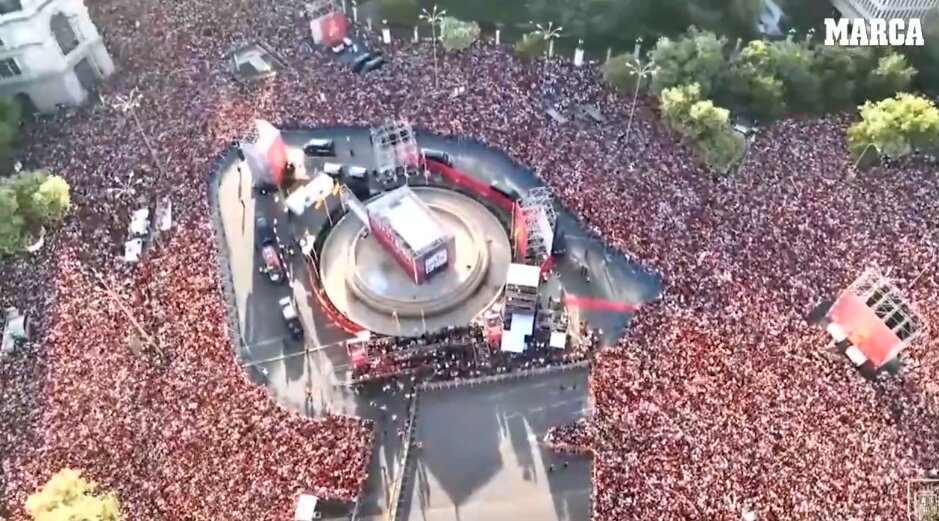
Nearly two million supporters flooded the streets of Madrid to welcome home the newly crowned FIFA World Cup champions after their dramatic 1-0 extra-time victory over Argentina in New Jersey. The parade became one of the largest public celebrations in modern Spanish history, eclipsing even many of the unforgettable scenes that followed Spain’s first World Cup triumph in South Africa sixteen years earlier.
For one extraordinary day, politics, regional identities, and everyday concerns seemed to disappear.
Spain was united behind one team.
A Nation Waiting to Celebrate
The excitement began long before the players landed in Madrid.
Throughout the night following the World Cup Final, spontaneous celebrations erupted across the country.
Supporters packed Madrid’s Plaza de Cibeles, Barcelona’s Plaça de Catalunya, Valencia’s Plaza del Ayuntamiento, Seville, Bilbao, Málaga, Zaragoza, and dozens of other cities. Car horns echoed through the streets while families waved Spanish flags and sang long into the early morning.
Everyone knew, however, that the biggest celebration would come the following day.
When the national team’s plane touched down at Madrid-Barajas Airport, thousands of supporters had already gathered nearby despite the summer heat.
That was merely the beginning.
Official Welcome Before the Party
As tradition dictates, Spain’s new world champions first fulfilled a series of official engagements before joining the public celebration.
The squad visited the Zarzuela Palace, where King Felipe VI congratulated the players, coaching staff and federation officials for bringing a second World Cup title to Spain. The monarch praised not only their footballing excellence but also their resilience, unity and sportsmanship throughout the tournament.
The team then traveled to La Moncloa, where Prime Minister Pedro Sánchez welcomed the champions and thanked them for creating what he described as “an unforgettable moment of national unity.” He even challenged the squad to return in 2030 with the ambition of winning a third World Cup.
Only after these ceremonies did the celebration everyone had been waiting for finally begin.
Madrid Turns Red and Gold
Once the players boarded their open-top bus, Madrid became one enormous football festival.
Government estimates placed the crowd at approximately 1.8 to 2 million people, making it one of the largest sporting celebrations ever held in Spain.
Every available space along the parade route filled with supporters.
Families climbed onto balconies.
Children sat on their parents’ shoulders.
Flags covered nearly every building overlooking the procession.
Many supporters had arrived before sunrise simply to guarantee themselves a place.
When the team bus finally appeared carrying the World Cup trophy, the roar that erupted across Madrid could reportedly be heard blocks away.
For several hours the city belonged entirely to La Roja.
The Trophy That United Spain
Captain Rodri stood proudly at the front of the bus, frequently lifting the famous golden FIFA World Cup trophy toward the supporters who had waited sixteen years to see it return home.
The image instantly became one of the defining photographs of Spanish sporting history.
Rodri later reflected on the achievement by acknowledging the inspiration provided by Spain’s 2010 world champions while emphasizing that this new generation had created its own legacy.
Two stars now adorn Spain’s shirt.
Only a handful of nations can say the same.
Video Spain’s World Cup Champions Parade
The Stars Enjoy Their Moment
Unlike the tension and discipline required throughout the tournament, the parade allowed the players to relax.
Perhaps nobody enjoyed the celebration more than Lamine Yamal.
The teenage sensation danced throughout much of the parade alongside close friend Nico Williams, delighting supporters with the same joy and spontaneity that made him one of the stars of the tournament. Videos of Yamal celebrating quickly spread across social media, becoming some of the day’s most shared moments.
Meanwhile, Marc Cucurella entertained fans by playing drums during the festivities, while striker Borja Iglesias embraced the role of unofficial team DJ, providing the soundtrack for an unforgettable afternoon.
The atmosphere felt less like a formal victory parade and more like one giant street festival.
Ferran Torres: From Match Winner to National Hero
If one player’s status changed forever during the World Cup Final, it was Ferran Torres.
His extra-time goal against Argentina secured Spain’s second World Cup championship and instantly elevated him into Spanish football folklore.
During the parade, supporters repeatedly chanted his name.
Every time Torres approached the edge of the bus to acknowledge the crowd, thousands responded with deafening applause.
Later that evening, Rodri paid special tribute to Torres during the official celebrations, recognizing the substitute whose decisive finish had delivered football immortality.
Some goals win matches.
Others become part of a nation’s sporting identity.
Torres’ strike belongs firmly in the second category.
Luis de la Fuente’s Masterpiece
Although much attention naturally focused on the players, Spain’s supporters also celebrated the man who transformed this talented generation into world champions.
Luis de la Fuente inherited a squad overflowing with technical quality.
His achievement was forging those individuals into perhaps the world’s most complete national team.
Throughout the tournament Spain consistently controlled possession, pressed intelligently, defended collectively and attacked with remarkable fluidity.
The final against Argentina perfectly summarized those qualities.
Spain dominated possession, dictated tempo and patiently searched for the breakthrough before Ferran Torres finally delivered the winning goal in extra time.
Many supporters now regard De la Fuente alongside Vicente del Bosque and Luis Aragonés among the greatest coaches in Spanish football history.
More Than a Football Victory
Perhaps the most remarkable aspect of the celebration was its symbolism.
Spain has often experienced political, cultural and regional divisions.
Football does not erase those realities.
But for one extraordinary afternoon, millions of people from every background celebrated together.
The images from Madrid showed supporters of every age waving flags, singing together and sharing in a collective sense of pride.
International media repeatedly described the celebration as one of unity rather than division.
That may ultimately become one of this team’s greatest achievements.
A New Golden Generation
Sixteen years separated Spain’s two World Cup titles.
The heroes are different.
The style has evolved.
Yet many supporters now believe this generation could prove even more successful.
Lamine Yamal remains only at the beginning of what promises to be an extraordinary career.
Rodri has become the world’s premier defensive midfielder.
Pau Cubarsí, Nico Williams, Pedri, Gavi and several other young stars suggest Spain could remain among football’s elite for many years.
Winning the UEFA European Championship and then the FIFA World Cup in consecutive major tournaments has firmly established Spain as the current benchmark in international football.
A Celebration for the History Books
The final scenes of the evening perfectly captured the significance of the moment.
As fireworks illuminated Madrid’s skyline and music echoed across the city, the players stood together on stage with the World Cup trophy raised high above their heads.
Nearly two million supporters celebrated below them.
It was not simply a parade.
It was the culmination of sixteen years of waiting, dreaming and believing.
Future generations will remember Ferran Torres’ winning goal.
They will remember Lamine Yamal’s breathtaking emergence.
They will remember Rodri lifting the trophy.
And they will remember the day when nearly two million Spaniards transformed Madrid into one giant sea of red and gold.
For one unforgettable afternoon, Spain did not merely celebrate becoming world champion.
It celebrated becoming part of football history.
Stay on top of TheWorldCup2026.com!


