
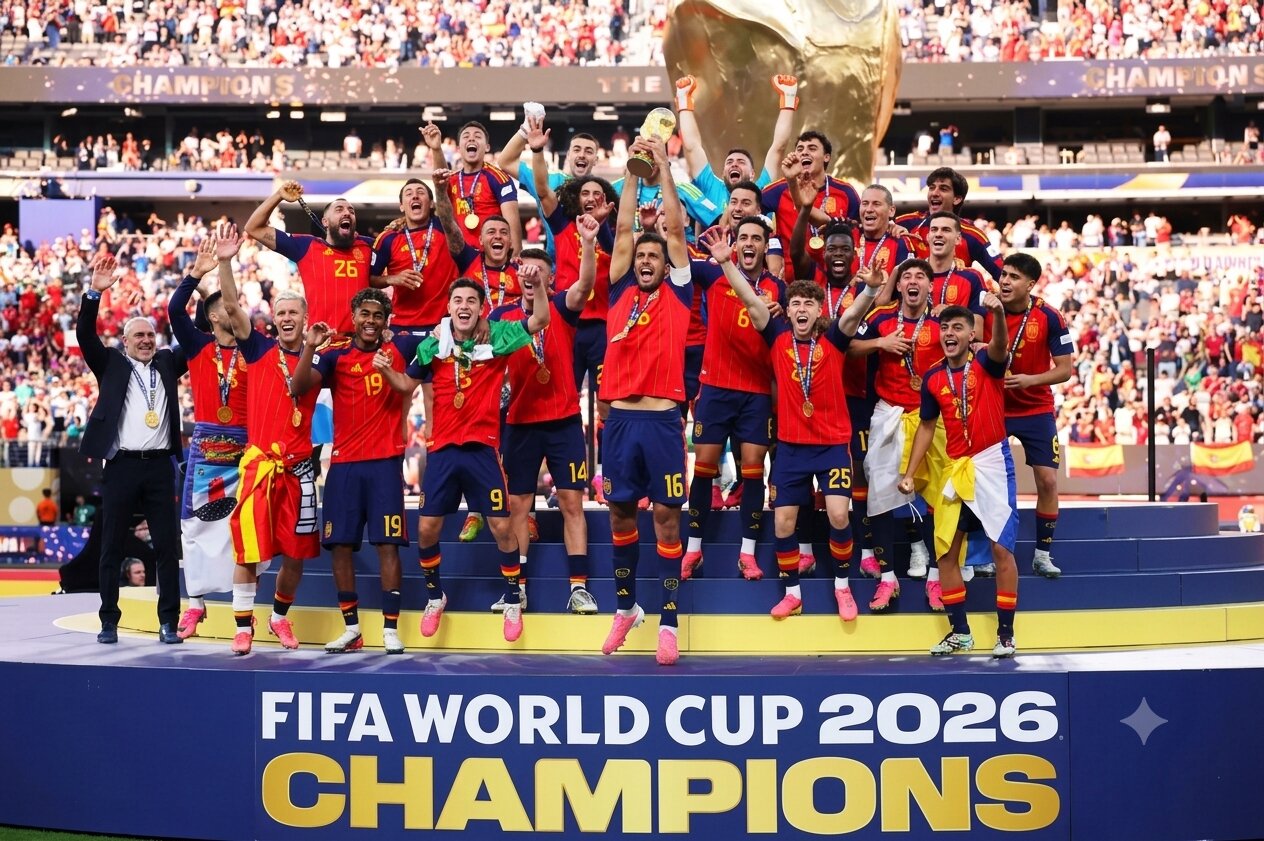
Spain 1–0 Argentina World Cup 2026 Final: Complete Analysis of the 2026 FIFA World Cup Final
For more than a month, the FIFA World Cup 2026 produced unforgettable drama across North America. There were stunning upsets, emotional comebacks, spectacular goals, and new stars announcing themselves on football’s biggest stage. Yet the tournament’s final match delivered something different: ninety minutes of tactical brilliance followed by thirty minutes of relentless determination before Spain finally broke Argentina’s resistance.
When substitute Ferran Torres scored in the 106th minute, he did far more than win a football match. He ended Argentina’s reign as world champion, crowned Spain for the second time in its history, and confirmed that the country’s remarkable new generation has become the standard by which international football will now be measured.
Two Giants, Two Different Journeys
Both finalists arrived at MetLife Stadium deserving their place, but they had taken very different paths.
Argentina entered the final carrying the weight of history. Four years after lifting the World Cup in Qatar, Lionel Scaloni’s squad had once again shown resilience throughout the knockout rounds. They survived an exhausting extra-time battle against Switzerland before defeating England in a dramatic semifinal. Led by Lionel Messi, Julián Álvarez, Alexis Mac Allister and goalkeeper Emiliano Martínez, Argentina appeared ready to defend its crown one final time.
Spain’s journey looked entirely different.
Luis de la Fuente’s team arrived not through dramatic escapes but through sustained excellence. The reigning European champions consistently controlled matches through intelligent possession, relentless pressing, and technical superiority. Every opponent eventually found themselves chasing the ball while Spain patiently dictated the rhythm.
By kickoff, many observers believed this Spanish team represented the future of international football.
The final proved them right.
Live Transmission of Celebration in Madrid: Spain 1-0 Argentina World Cup 2026 Final
A Clash of Football Philosophies
The championship match was fascinating because it featured two completely different football identities.
Spain wanted the ball.
Argentina wanted the moments.
Luis de la Fuente built his side around the same principles that made Spain famous during its golden era, but with greater verticality and athleticism. Rodri anchored midfield while Dani Olmo, Fabián Ruiz, Alex Baena and Lamine Yamal constantly exchanged positions to create passing triangles all over the pitch. Spain lined up in its familiar 4-2-3-1 shape but often resembled a fluid attacking machine whenever possession settled in Argentina’s half.
Argentina, meanwhile, accepted that Spain would enjoy more possession.
Lionel Scaloni instead trusted his experienced defenders, disciplined midfield, and the brilliance of Emiliano Martínez to absorb pressure before launching quick counterattacks through Messi and Julián Álvarez.
For long stretches, that strategy worked.
But only because Martínez produced one of the greatest goalkeeping performances ever seen in a World Cup Final.
Spain Takes Control
From the opening whistle there was little doubt about which team intended to dictate the game.
Spain monopolized possession.
Rodri calmly recycled passes from side to side, stretching Argentina’s defensive block until small openings began to appear.
Pedro Porro and Marc Cucurella pushed high up the wings.
Lamine Yamal repeatedly isolated defenders one-on-one.
Dani Olmo drifted between midfield and attack, constantly searching for dangerous pockets of space.
Argentina defended with admirable discipline, but it rarely managed to establish sustained possession of its own.
Statistics reflected exactly what spectators were seeing.
Spain controlled nearly two-thirds of possession while creating twenty shots compared with only two for Argentina. The defending champions failed to register a single shot during normal time, a remarkable illustration of Spain’s defensive organization and midfield dominance.
Emiliano Martínez Keeps Argentina Alive
If Spain controlled the match, Emiliano Martínez controlled the scoreline.
Time after time, the Argentine goalkeeper denied Spain.
He reacted brilliantly to close-range chances.
He dominated aerial balls.
He organized the defense with remarkable authority.
Every Spanish attack seemed destined to end with Martínez making another spectacular save.
His extraordinary performance transformed what could have become a comfortable Spanish victory into an unforgettable final.
Without Martínez, Spain might have scored three or four goals before halftime.
Instead, Argentina remained alive.
Sometimes football’s greatest performances come in defeat.
Martínez produced exactly that kind of performance.
Messi’s Last World Cup
For Lionel Messi, this was more than another final.
At thirty-nine years old, this was widely expected to be his final appearance on football’s biggest stage.
Although Spain’s relentless pressing limited his opportunities, Messi continued searching for moments of magic whenever Argentina recovered possession.
Every touch generated anticipation.
Every forward run reminded supporters why he remains one of football’s greatest players.
But unlike the triumphant evening in Qatar four years earlier, this final belonged to younger legs and fresher energy.
Spain never allowed Messi to control the match.
Rodri and Spain’s midfield consistently surrounded him before dangerous attacks could develop.
It was a respectful but ruthless performance against one of the sport’s greatest icons.
The Match Grows Increasingly Physical
As frustration mounted, the contest became increasingly physical.
Argentina committed tactical fouls to slow Spain’s rhythm.
Spain responded by increasing the tempo even further.
Every loose ball became fiercely contested.
Every challenge carried greater significance.
Despite Spain’s dominance, Argentina’s disciplined defending continued forcing extra passes rather than clear scoring opportunities.
The longer the match remained scoreless, the more nervous Spanish supporters became.
Could Argentina somehow steal another World Cup through one decisive counterattack?
That question lingered throughout the second half.
A Turning Point Before Extra Time
Just as extra time approached, Argentina suffered a devastating blow.
Midfielder Enzo Fernández received a second yellow card, reducing Argentina to ten men for the entire extra-time period.
The dismissal completely altered the tactical landscape.
Already struggling to maintain possession against Spain’s technical midfield, Argentina now faced the impossible task of defending enormous spaces while a man short.
Spain immediately sensed the opportunity.
The pressure intensified.
Possession became almost constant.
Argentina’s exhausted defenders found themselves chasing shadows.
Video Spain 1–0 Argentina World Cup 2026 Final Goal and Match Highlights
Ferran Torres Delivers Immortality
Football history often belongs to substitutes.
Ferran Torres entered knowing one decisive contribution could define his career forever.
He delivered exactly that.
Early in the second period of extra time, Nico Williams won possession and cleverly headed the ball into the danger area.
Torres reacted first.
The substitute struck a left-footed finish beneath the crossbar before Martínez could recover.
After more than one hundred minutes of relentless Spanish pressure, the breakthrough had finally arrived.
MetLife Stadium exploded.
Spain’s players sprinted toward the corner flag.
The Spanish bench emptied.
The goal felt inevitable because Spain had earned it through complete territorial dominance.
Torres had become a national hero.
Why Spain Deserved the Title
Final scorelines sometimes hide the true balance of a match.
This one did not.
Although the scoreboard showed only 1–0, Spain dominated virtually every important aspect of the contest.
They controlled possession.
They created the overwhelming majority of scoring opportunities.
They completed far more passes.
They dictated the tempo.
They limited Argentina to almost no attacking football.
Perhaps the most telling statistic was the shot count.
Spain attempted twenty shots.
Argentina managed only two.
The defending champions remained competitive because of Martínez’s brilliance—not because they controlled the match.
When Ferran Torres finally scored, it felt less like a surprise than the inevitable reward for more than one hundred minutes of superior football.
Luis de la Fuente’s Masterclass
Much credit belongs to Spain’s manager.
Luis de la Fuente has quietly built one of the most complete national teams of the modern era.
Unlike Spain’s famous 2010 side, this version combines patient possession with direct attacking speed.
Lamine Yamal and Nico Williams stretch defenses.
Rodri controls rhythm.
Dani Olmo constantly finds dangerous spaces.
Fabián Ruiz provides creativity.
Defensively, Pau Cubarsí, Aymeric Laporte, Pedro Porro and Marc Cucurella give opponents very few clear chances.
The tactical balance is exceptional.
Throughout the tournament Spain consistently looked like the most complete team.
The final confirmed it.
Argentina Leaves with Pride
Although Argentina failed to retain its title, this tournament should not be viewed as a disappointment.
Reaching consecutive World Cup Finals is an extraordinary achievement.
Scaloni again demonstrated his ability to organize an intelligent, resilient team capable of competing against anyone.
Young players gained invaluable experience.
Julián Álvarez continued proving himself among the world’s elite strikers.
Alexis Mac Allister remained influential.
Martínez enhanced his reputation even in defeat.
Most importantly, Argentina leaves knowing it fought until the very end despite facing perhaps the strongest national team currently assembled anywhere in the world.
A New Golden Generation
For Spain, this victory feels different from 2010.
That team revolutionized football through possession.
This one appears even more versatile.
Lamine Yamal may become the defining player of his generation.
Rodri has established himself as the world’s premier holding midfielder.
Pau Cubarsí already performs with astonishing maturity.
Ferran Torres has written himself into Spanish football history.
Together they represent a squad capable of dominating international football for years to come.
Winning both the UEFA European Championship and the FIFA World Cup within two years confirms Spain’s position as the sport’s current benchmark.
Spain 1–0 Argentina World Cup 2026 Final: Spain is A Worthy Champion
Every World Cup produces one team that stands above the rest.
In 2026, that team was Spain.
Their football combined elegance with efficiency.
Creativity with discipline.
Possession with purpose.
They did not simply survive difficult matches.
They controlled them.
Against Argentina they demonstrated patience when the breakthrough refused to come, composure when frustration mounted, and determination when extra time demanded one final effort.
Champions are remembered not merely for lifting trophies but for how they play.
Spain leaves North America having reminded the football world that beautiful football and winning football can still be the same thing.
As captain after captain lifted the famous golden trophy into the New Jersey night, there was little debate about whether the right team had won.
Spain had not only conquered Argentina.
It had conquered the world—and done so with a style worthy of football’s greatest prize.
Keep up with TheWorldCup2026.com!


