
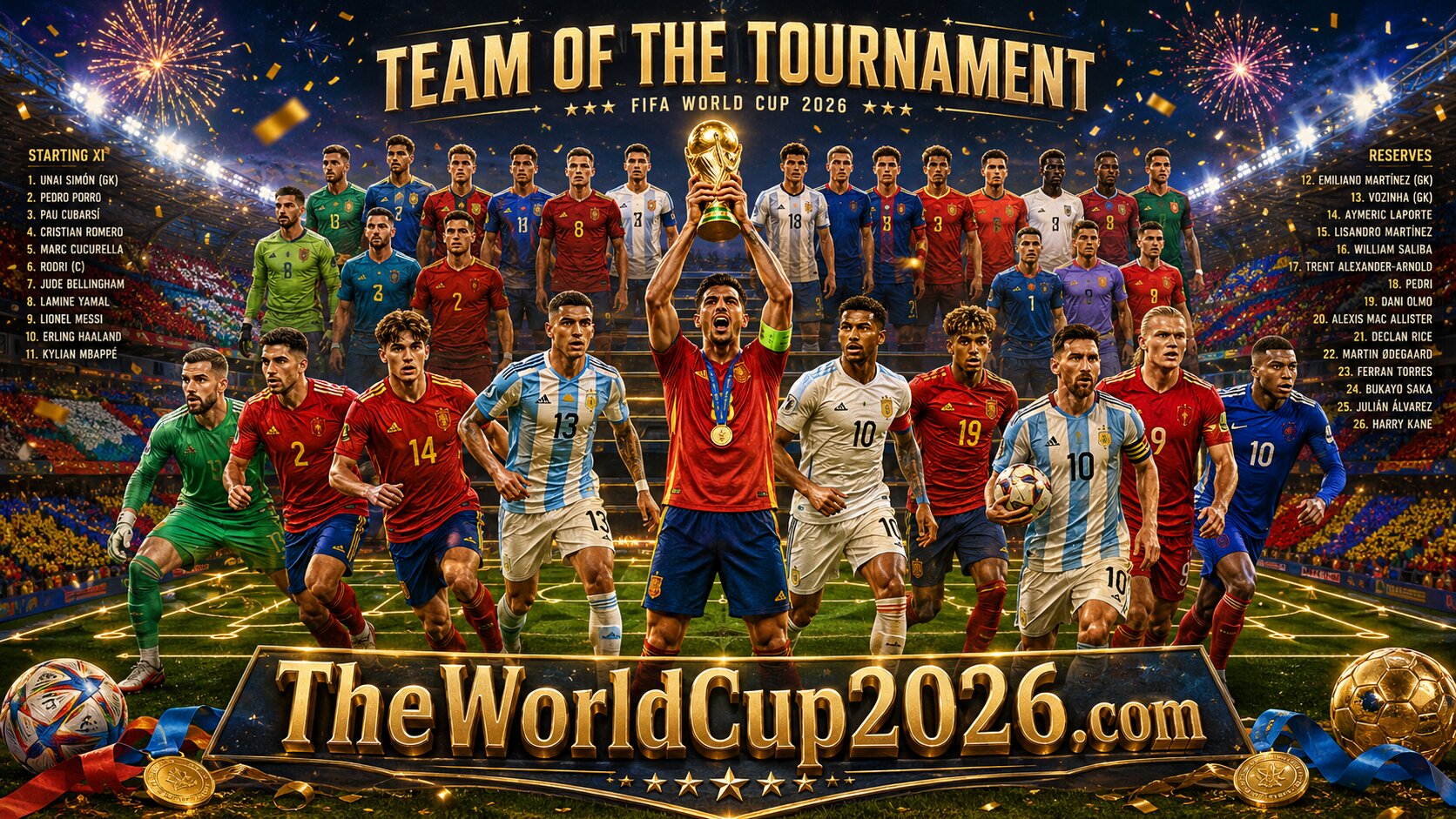
World Cup 2026 Team of the Tournament: The Ultimate Best XI and 15 Reserve Players
The 2026 FIFA World Cup delivered everything football supporters could have hoped for: unforgettable matches, emerging superstars, legendary performances, and one of the highest overall levels of play ever seen in an international tournament.
Once Spain defeated Argentina 1-0 after extra time in the World Cup Final, attention immediately shifted toward another debate every football fan loves:
Who belongs in the Team of the Tournament?
Several respected media organizations—including ESPN, FOX Sports, talkSPORT, and numerous European newspapers—have published their own Best XI selections. While there is broad agreement on several positions, there are also fascinating differences that reflect how difficult it was to choose among so many outstanding performers.
After reviewing those selections and evaluating each player’s performances throughout the tournament, here is TheWorldCup2026.com’s Ultimate 26-Man World Cup Team.
Formation: 4-3-3
This formation best reflects modern football while accommodating the tournament’s finest attacking talent.
Goalkeeper
Unai Simón (Spain)
Several outlets selected Cape Verde veteran Vozinha after his remarkable underdog run, while others chose Spain’s Unai Simón. Both cases are compelling.
For this team, however, Unai Simón gets the nod.
He conceded only a handful of goals throughout the tournament, organized the competition’s best defense, remained composed under pressure, and made crucial saves during Spain’s march to the championship. Great goalkeepers are often judged by their biggest moments, and Simón delivered exactly that during the knockout rounds.
Defense
Right Back
Pedro Porro (Spain)
Porro transformed Spain’s right flank into an attacking weapon.
His overlapping runs consistently stretched opposing defenses, while his recovery speed ensured Spain rarely became vulnerable defensively. His semifinal goal against France symbolized an outstanding tournament.
Center Back
Pau Cubarsí (Spain)
Only nineteen years old, Cubarsí played with the maturity of a veteran.
Rarely caught out of position, exceptional with the ball, fearless under pressure, and remarkably calm against elite forwards, he announced himself as one of football’s next great defenders.
Center Back
Cristian Romero (Argentina)
Although Spain won the World Cup, Romero was arguably the tournament’s toughest defender.
His physical presence, anticipation and leadership kept Argentina alive in several knockout matches, particularly against England and Spain.
Left Back
Marc Cucurella (Spain)
Few defenders influenced both ends of the field more consistently.
His relentless energy, defensive discipline and attacking support made him indispensable throughout Spain’s championship run.
Midfield
Defensive Midfielder
Rodri (Spain)
No selection generates less debate.
Rodri controlled nearly every match Spain played.
His positioning, passing range and tactical intelligence allowed Spain to dominate possession against every opponent.
Many journalists selected him as the Player of the Tournament, and it is difficult to disagree.
Central Midfielder
Jude Bellingham (England)
England may have finished third, but Bellingham elevated himself into football’s absolute elite.
His seven-goal tournament, leadership, defensive work and ability to influence every phase of the game made him England’s indispensable player.
Attacking Midfielder
Lamine Yamal (Spain)
No teenager has ever dominated a World Cup quite like Lamine Yamal.
His dribbling terrified defenders.
His vision constantly unlocked defenses.
His maturity far exceeded his age.
Although he did not finish as the tournament’s leading scorer, few players created more danger.
Attack
Right Wing
Lionel Messi (Argentina)
At thirty-nine years old, Messi somehow produced another extraordinary World Cup.
His leadership inspired Argentina through difficult knockout matches against Egypt, Switzerland and England.
Although Spain finally denied him a second consecutive World Cup title, his performances confirmed once again why many consider him football’s greatest player.
Center Forward
Erling Haaland (Norway)
Norway’s remarkable run to the quarterfinals owed much to Haaland.
His movement, finishing and physical dominance overwhelmed elite defenders throughout the tournament.
Every opponent had to change its defensive approach simply because he was on the field.
Left Wing
Kylian Mbappé (France)
Mbappé finished as the tournament’s Golden Boot winner while once again demonstrating why he remains one of football’s most devastating attackers. His spectacular performances nearly carried France into another World Cup Final despite the team’s eventual semifinal defeat.
The 15 Reserve Players
A complete tournament squad needs far more than eleven outstanding footballers.
These fifteen players narrowly missed the starting lineup but deserve recognition among the tournament’s elite.
Goalkeepers
Emiliano Martínez (Argentina)
His incredible performance in the World Cup Final almost single-handedly denied Spain for more than one hundred minutes.
Vozinha (Cape Verde)
Perhaps the tournament’s biggest surprise.
At forty years old, he produced one spectacular performance after another while leading Cape Verde to an unforgettable World Cup.
Several major media outlets actually selected him as their first-choice goalkeeper.
Defenders
Aymeric Laporte (Spain)
A calm, experienced leader throughout Spain’s championship run.
Lisandro Martínez (Argentina)
Outstanding defensive performances throughout the knockout rounds.
William Saliba (France)
France’s most consistent defender.
Trent Alexander-Arnold (England)
An attacking weapon whose passing repeatedly changed matches.
Midfielders
Pedri (Spain)
His creativity and intelligence remained essential whenever Spain controlled possession.
Dani Olmo (Spain)
Several publications actually included Olmo in their starting Best XI. His creativity and movement constantly unsettled opposing defenses.
Alexis Mac Allister (Argentina)
The heartbeat of Argentina’s midfield.
Declan Rice (England)
Outstanding defensive midfielder whose tournament ended with England’s bronze medal.
Martin Ødegaard (Norway)
Norway’s captain orchestrated nearly every attack during the country’s historic run.
Forwards
Ferran Torres (Spain)
He will forever be remembered for scoring the winning goal in the World Cup Final.
History remembers decisive moments, and few were bigger than his strike in extra time.
Bukayo Saka (England)
England’s hat-trick hero in the unforgettable 6-4 victory over France.
His pace and finishing were among the tournament’s highlights.
Julián Álvarez (Argentina)
Scored important knockout goals while forming an outstanding partnership with Messi.
Harry Kane (England)
Although omitted from some media selections, Kane remained England’s captain and one of the tournament’s most influential forwards. His omission from some Best XIs illustrates just how competitive the attacking positions were.
The Toughest Omissions
Every Team of the Tournament leaves deserving players disappointed.
Among those narrowly missing the final twenty-six are:
- Nico Williams (Spain)
- Michael Olise (France)
- Achraf Hakimi (Morocco)
- Bruno Fernandes (Portugal)
- Vinícius Júnior (Brazil)
- João Neves (Portugal)
- Manuel Koné (France)
Each produced moments worthy of recognition but faced extraordinary competition.
World Cup 2026 Team of the Tournament: What the Experts Agreed On
Although different publications selected different formations and personnel, remarkable consensus emerged.
Almost every reputable Team of the Tournament included:
- Rodri
- Lamine Yamal
- Jude Bellingham
- Kylian Mbappé
- Lionel Messi
- Pedro Porro
- Marc Cucurella
Most also heavily favored Spain, reflecting the simple reality that the world champions consistently played the tournament’s best football. Some selections featured as many as six Spanish players in the starting XI.
Spain Defines the Tournament
Ultimately, every World Cup Team of the Tournament reflects one simple truth.
The champions usually dominate.
Spain did exactly that.
Rodri controlled matches.
Cubarsí matured into a world-class defender.
Porro and Cucurella revolutionized attacking full-back play.
Lamine Yamal emerged as football’s brightest young superstar.
Ferran Torres scored the goal that secured immortality.
Yet this tournament also reminded us that greatness extends beyond lifting the trophy.
Messi produced another unforgettable farewell.
Mbappé confirmed his place among football’s greatest modern forwards.
Bellingham became England’s unquestioned leader.
Haaland carried Norway further than anyone expected.
Martínez and Vozinha produced heroic performances in goal.
Together, these twenty-six footballers represent the very best that the 2026 FIFA World Cup had to offer—a collection of established legends, emerging superstars, and unforgettable performers whose achievements will be remembered long after the confetti settled in New Jersey.
Stay on top of TheWorldCup2026.com!


