
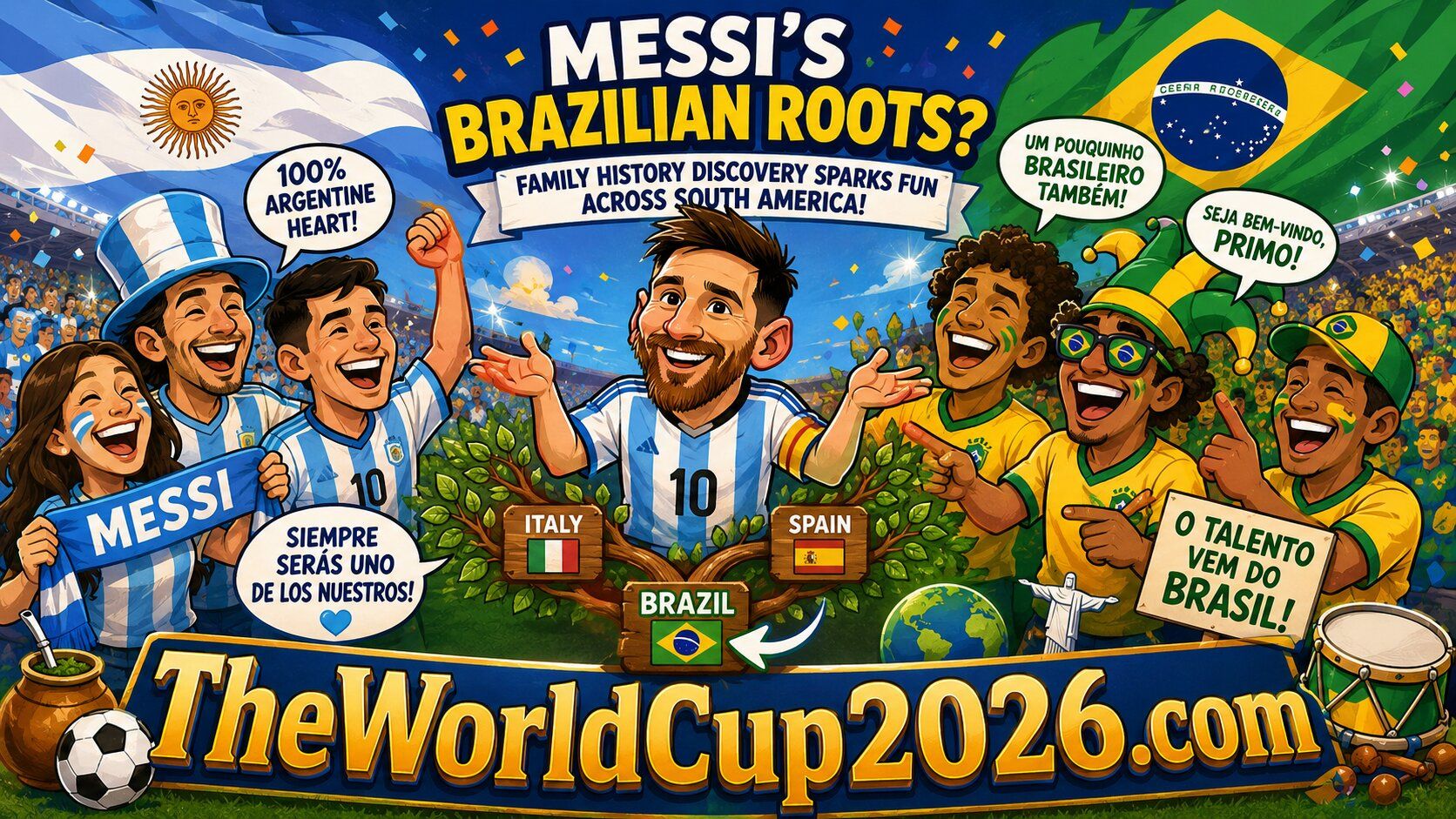
Messi’s Brazilian Roots? Lionel Messi’s Alleged Brazilian Ancestry Sparks Debate and Hilarious Reactions Across South America
Football rivalries rarely stay confined to the pitch.
Sometimes they spill into television studios, family history, genealogy websites, and—perhaps most entertainingly—social media. That is precisely what happened after recent reports suggested that Lionel Messi’s family tree may include previously overlooked Brazilian roots. What might have remained an interesting genealogical discovery quickly became one of the most talked-about football stories in South America, provoking curiosity, national pride, and an avalanche of jokes from Brazilian supporters.
Although the story has been treated lightheartedly by most observers, it has touched on something much deeper: the unique relationship between Argentina and Brazil, two football nations whose rivalry has shaped the history of the sport for more than a century.
The Discovery That Started the Conversation
According to a report published by MARCA, genealogical research uncovered evidence suggesting that part of Lionel Messi’s extended family history may trace back to Brazil before later branches settled in Argentina. The article emphasized that the discovery relates to distant ancestry rather than Messi’s nationality or personal identity, but that distinction did little to slow the story’s spread across South American media.
Within hours, newspapers, television programs and football websites were discussing the possibility that one of Argentina’s greatest sporting icons might also have a small Brazilian branch somewhere in his family tree.
For football supporters, that was irresistible.
Why the Story Became So Popular
Ordinarily, discoveries about family ancestry attract limited attention.
This one became enormous because of who Lionel Messi is.
For nearly twenty years Messi has represented Argentina in what many consider football’s greatest international rivalry.
Whether in Copa América finals, World Cup qualifying matches or countless friendly encounters, Messi has become one of the defining faces of Argentine football during an era in which Brazil has often been Argentina’s principal rival.
To imagine—even jokingly—that Messi might possess distant Brazilian ancestry was enough to send football fans into a frenzy.
The timing made the story even bigger.
Only days earlier, Messi had completed what many believe was his final FIFA World Cup appearance, leading Argentina to another World Cup Final before narrowly losing 1–0 to Spain after extra time. His legendary career remains fresh in everyone’s mind, ensuring that almost any story connected to him immediately becomes international news.
Brazilian Fans Respond with Humor
If there is one thing Brazilian football supporters do exceptionally well, it is humor.
Rather than treating the report seriously, many embraced it as an opportunity for playful rivalry.
Images, memes and edited graphics rapidly circulated across social media.
One widely shared post jokingly welcomed Messi as an “honorary Brazilian,” while others humorously claimed that his dribbling ability, creativity and love of beautiful football suddenly “made perfect sense.”
The viral posts were clearly intended as friendly teasing rather than genuine historical claims.
Some supporters joked that Brazil could now “claim” part of Messi’s legacy.
Others playfully argued that one of Argentina’s greatest players had finally revealed “where the football really came from.”
The humor worked precisely because everyone understood the larger context.
Nobody genuinely questioned Messi’s lifelong identity as an Argentine.
Instead, supporters enjoyed poking fun at one of football’s oldest rivalries.
Argentina and Brazil: Football’s Greatest Rivalry
To understand why the story became so popular, it helps to appreciate the extraordinary history between the two nations.
Argentina and Brazil have spent decades competing for supremacy in South American football.
Between them they have produced legends including Pelé, Garrincha, Zico, Romário, Ronaldo, Ronaldinho, Neymar, Diego Maradona and Lionel Messi.
Each generation has produced new debates.
Pelé or Maradona?
Ronaldo or Batistuta?
Neymar or Messi?
Those arguments have fueled football conversations across the continent for decades.
The rivalry extends well beyond individual matches.
It has become part of each nation’s sporting identity.
That explains why even a genealogy story could become headline news.
Messi’s Identity Has Never Been in Doubt
While the Brazilian jokes have been entertaining, it is important to separate playful social media from reality.
Lionel Messi was born in Rosario, Santa Fe, grew up in Argentina, represented Argentina throughout his international career, captained the national team, won the Copa América, lifted the FIFA World Cup in 2022, and reached another World Cup Final in 2026. His footballing identity has always been inseparable from Argentina.
Modern genealogical research frequently uncovers distant family connections that cross national borders.
South America has experienced centuries of migration among neighboring countries, making discoveries like these far less surprising than they might initially appear.
The reported ancestral link therefore says more about the rich history of migration across the region than it does about Messi himself.
Football Beyond Borders
Perhaps the most interesting aspect of the story is what it reveals about football culture.
Supporters often define themselves through national teams.
Yet football itself has always crossed borders.
Players develop careers in different countries.
Families migrate.
Cultures blend.
Messi himself is a perfect example.
Born in Argentina.
Developed as a footballer in Spain.
Became a Barcelona legend.
Played in France.
Now stars in Major League Soccer in the United States.
His career has connected football supporters across several continents.
The reported discovery of distant Brazilian ancestry simply adds another fascinating chapter to that international story.
Why Fans Loved the Story
The popularity of the story also reflects something uniquely human.
Supporters enjoy discovering unexpected connections between rivals.
Had similar research suggested distant Argentine ancestry for Pelé or Brazilian ancestry for Maradona, reactions would likely have been equally enthusiastic.
Stories like these remind supporters that even fierce sporting rivalries exist within a broader shared cultural history.
South Americans may passionately debate football.
But they also recognize the continent’s interconnected heritage.
That helps explain why the overwhelming response has been laughter rather than controversy.
Messi’s Legacy Remains Untouched
If anything, the story reinforces Messi’s extraordinary cultural influence.
Very few athletes could generate international headlines through a genealogy report.
Only global sporting icons possess that kind of reach.
Messi’s football achievements remain unchanged.
Eight Ballon d’Or awards.
Barcelona’s greatest player.
World Cup champion.
Two-time World Cup finalist.
One of the most decorated footballers in history.
No distant ancestral discovery alters those accomplishments.
Instead, the story simply offers supporters another reason to talk about one of the sport’s most fascinating figures.
A Reminder That Football Is Also About Joy
Modern football discussions often become dominated by statistics, tactics and endless debates over rankings.
This story offered something refreshingly different.
It reminded everyone that football is also supposed to be fun.
The memes.
The playful banter.
The exaggerated national pride.
The friendly teasing.
These are all part of what makes football the world’s most beloved sport.
Brazilian supporters could joke about “claiming” Messi.
Argentine supporters could laugh while reminding everyone which national team he actually represented.
Everyone understood the joke.
South America Wins Either Way
Perhaps the biggest lesson from this episode is that South American football continues to produce stories unlike any other region.
The continent has given the world Pelé, Maradona, Ronaldo, Ronaldinho, Neymar and Messi.
It has produced unforgettable World Cup finals, Copa América classics and generations of legendary players.
Now it has even produced an international debate about a footballer’s family tree.
Only in South America could genealogy become football news.
Only in South America could football supporters transform a historical curiosity into one of the week’s funniest stories.
Messi’s Brazilian Roots: More Than a Viral Moment
Whether additional genealogical research eventually confirms or refines the reported family connection, the broader significance of the story is already clear.
It illustrates the enormous cultural impact Lionel Messi continues to have long after completing what is expected to be his final World Cup.
It also highlights the healthy, humorous side of one of football’s greatest rivalries.
Supporters did what football supporters have always done.
They laughed.
They argued.
They created memes.
They celebrated the sport.
And they reminded everyone that while Argentina and Brazil may compete fiercely for football supremacy, they also share a common passion that transcends borders.
In the end, that may be the most meaningful discovery of all.
Stay on top of TheWorldCup2026.com!


