
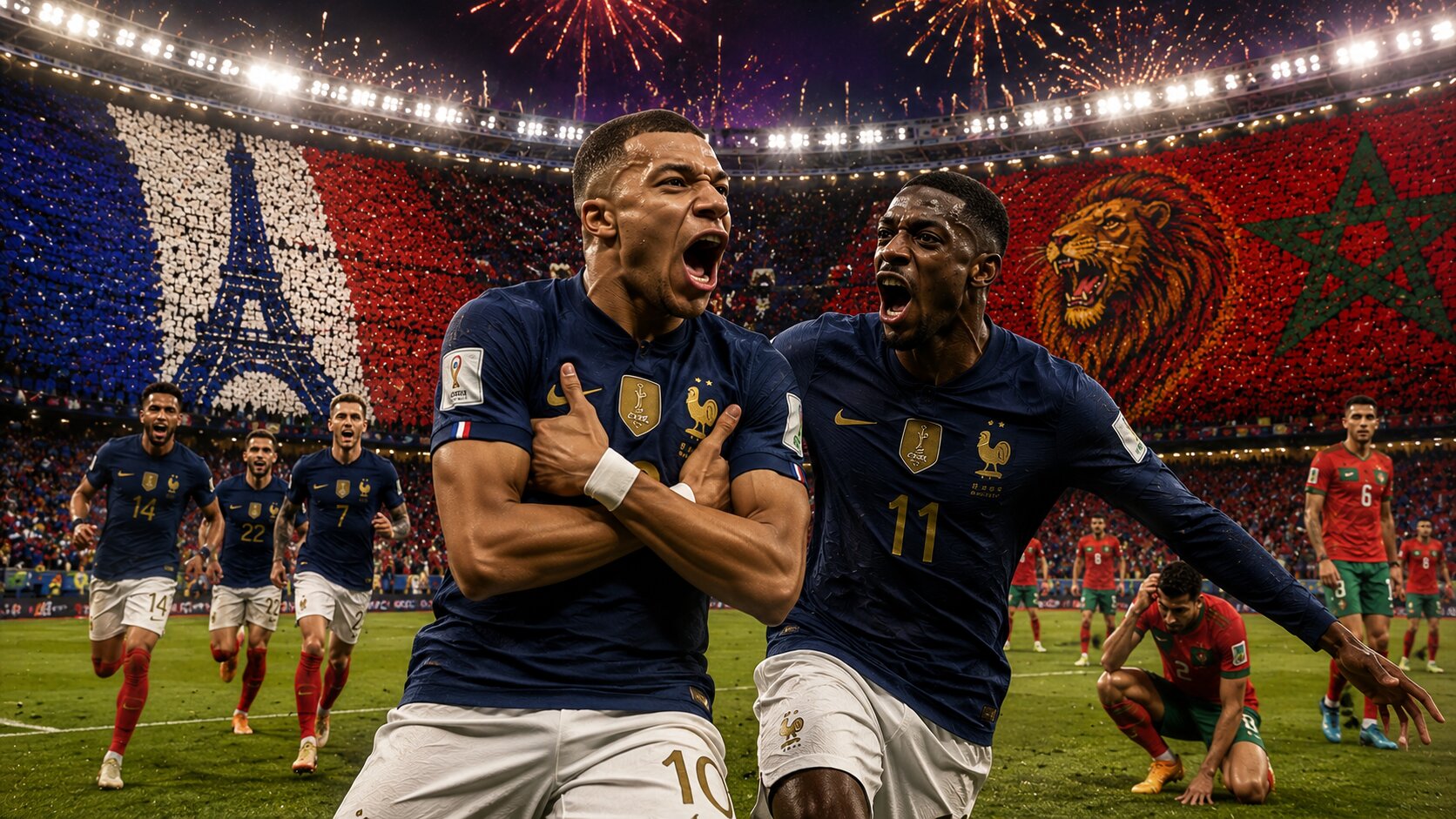
France 2-0 Morocco World Cup 2026 Analysis: Les Bleus End the Atlas Lions’ Historic Run and March Into the Semifinals
France is heading to the semifinals of the 2026 FIFA World Cup after defeating Morocco 2-0 in a quarterfinal that was far more competitive than the final score suggests.
The tournament favorites entered the match possessing greater depth, more individual talent, and extensive experience in the final stages of major competitions. Morocco arrived with confidence, defensive discipline, and the belief that it could eliminate another traditional football power. For significant stretches, the Atlas Lions challenged France, competed intensely in midfield, and threatened to transform the match into another historic chapter for Moroccan football.
France ultimately demonstrated why it remains one of the leading candidates to win the World Cup.
Les Bleus were patient when Morocco denied them space, composed when the Atlas Lions applied pressure, and clinical when decisive opportunities appeared. Morocco played with courage and tactical intelligence, but France’s superior finishing and ability to manage the most important periods produced a deserved 2-0 victory.
The result takes France into the semifinals, where it will face the winner of Spain versus Belgium. Morocco’s remarkable campaign ends, but the Atlas Lions leave the tournament having reinforced their position among international football’s most respected teams.
A Cautious Opening Filled With Tactical Tension
The opening stages reflected the enormous stakes.
France wanted to establish territorial control without exposing itself to Morocco’s dangerous counterattacks. Morocco wanted to remain compact, frustrate the French attackers, and identify opportunities to exploit the spaces behind France’s fullbacks.
Neither coaching staff was prepared to take unnecessary risks.
France circulated the ball patiently across the defensive and midfield lines. Rather than immediately forcing passes into crowded central areas, Les Bleus attempted to stretch Morocco horizontally and create openings around the edges of its defensive block.
Morocco responded with excellent organization.
The Atlas Lions maintained short distances between defense and midfield. Their wide players tracked French runners, while the central midfield worked tirelessly to prevent France from finding easy combinations near the penalty area.
For much of the opening phase, Morocco’s plan worked.
France controlled more possession, but clear chances were limited. Every French attacker who received the ball encountered immediate pressure. Morocco appeared confident, disciplined, and fully prepared for the challenge.
France Gradually Finds Its Rhythm
As the first half developed, France began moving the ball more quickly.
The midfield became more aggressive in its positioning. French attackers rotated across the front line, forcing Morocco’s defenders to make increasingly difficult decisions about when to follow runners and when to protect their zones.
Ousmane Dembélé became particularly important.
His acceleration and unpredictable movement repeatedly forced Morocco’s defenders backward. Even when he did not produce a shot or final pass, his ability to carry the ball into dangerous areas disrupted Morocco’s shape.
Kylian Mbappé also demanded constant attention. Morocco could not afford to leave him isolated against a single defender, so additional support was required whenever he received possession. That created space elsewhere and gradually increased the pressure on the Atlas Lions.
France did not dominate Morocco through nonstop chances. It weakened the Moroccan structure by making it defend repeatedly, move from side to side, and react to several different attacking threats.
The Opening Goal Changes the Match
The first goal was the match’s defining turning point.
Morocco had successfully denied France the early breakthrough it wanted, but one moment of hesitation was enough for Les Bleus to take advantage. France accelerated its attack, found space inside the Moroccan defensive structure, and completed the move with the composure expected from a tournament favorite.
The goal changed the tactical situation immediately.
Before falling behind, Morocco could remain patient and wait for counterattacking opportunities. After conceding, the Atlas Lions had to become more ambitious.
That created a difficult dilemma.
Morocco needed to push players forward to search for an equalizer, but doing so increased the space available to Mbappé, Dembélé, and the rest of France’s attack. Remaining too cautious would allow France to control the match. Becoming too aggressive could invite a devastating counterattack.
France had forced Morocco away from its preferred game.
Morocco Responds With Courage
Morocco did not collapse after conceding.
Instead, the Atlas Lions produced one of their strongest periods of the match.
Achraf Hakimi became more adventurous, pushing higher and attempting to create overloads on the right side. Morocco’s midfield increased its pressure, while the attackers made more direct runs toward the French penalty area.
The Atlas Lions began recovering possession in more advanced positions and generated moments of genuine danger. France’s defenders were forced to retreat, clear crosses, and defend several difficult sequences around the edge of the box.
Morocco’s performance during this phase reflected the character that had carried it so far.
The team did not accept defeat.
It did not abandon its organization.
It continued looking for a way back into the match.
The problem was that France remained remarkably calm.
France’s Defense Passes Another Major Test
France’s attack will receive much of the attention, but the defensive performance was one of the biggest reasons for the victory.
William Saliba and the rest of the back line remained composed when Morocco increased the pressure. They dealt effectively with crosses, tracked runners, and prevented the Atlas Lions from turning promising attacks into clear scoring opportunities.
France’s midfield protection was equally important.
Aurélien Tchouaméni helped close central spaces and disrupted several Moroccan transitions before they could become dangerous. When Morocco attempted to accelerate through midfield, France frequently slowed the attack and allowed its defensive structure to recover.
The clean sheet was not the result of Morocco offering no threat.
It was the result of France managing that threat effectively.
That distinction matters. Championship teams must survive difficult periods without losing control, and France did exactly that.
Video France 2-0 Morocco World Cup 2026 Goals and Extended Highlights
Dembélé and Mbappé Stretch Morocco to Its Limit
France’s two most dangerous attacking players posed different problems.
Dembélé repeatedly challenged defenders with close control, changes of direction, and acceleration. His willingness to attack one-on-one prevented Morocco from simply remaining compact in central areas.
Mbappé created a different kind of fear.
His pace forced Morocco’s defenders to maintain awareness of the space behind them at all times. Even when he was not receiving the ball, his runs affected Morocco’s positioning.
Together, they stretched the Atlas Lions both horizontally and vertically.
Morocco’s defenders performed admirably for long periods, but the constant pressure required enormous concentration and physical effort. As the match moved deeper into the second half, France’s depth and athleticism became increasingly influential.
Hakimi Leads Morocco With Pride
Achraf Hakimi was once again one of Morocco’s most important players.
He competed intensely in defense, supported attacks, and continued demanding the ball even as the match became more difficult. His leadership was visible in the way he encouraged teammates and attempted to raise the tempo after France took the lead.
Sofyan Amrabat also delivered a committed midfield performance. He challenged French players physically, protected the defense, and attempted to organize Morocco’s transitions.
Youssef En-Nesyri worked tirelessly against France’s central defenders but received limited space and few clear opportunities. His movement created problems, yet France successfully prevented him from becoming decisive inside the penalty area.
Morocco’s key players did not disappear. They were simply facing a French team capable of matching their intensity while offering greater quality in the decisive areas.
The Second Goal Ends Morocco’s Resistance
As Morocco pushed forward in search of an equalizer, the match inevitably became more open.
France found additional space in transition and began threatening more frequently. Morocco continued competing, but the physical demands of chasing the game became increasingly visible.
The second French goal effectively ended the contest.
It was the product of France’s patience and Morocco’s growing need to take risks. Les Bleus identified the opening, moved the ball decisively, and punished the Atlas Lions with another clinical finish.
At 2-0, Morocco faced an almost impossible task.
France reduced unnecessary risks, controlled possession more carefully, and used its experience to manage the closing stages. Morocco continued attacking, but the emotional and tactical balance had shifted permanently.
A Victory Built on Tactical Maturity
France did not win through reckless attacking football.
It won through maturity.
The French coaching staff understood that Morocco wanted a tight, emotional match in which pressure would gradually build on the favorite. France refused to become impatient.
Les Bleus moved the ball methodically, trusted their individual quality, and waited for Morocco’s structure to weaken. After taking the lead, they did not lose their discipline when Morocco responded.
The substitutions also helped France maintain energy and control. Fresh players ensured that Morocco could not dominate the final stages through physical intensity alone.
Morocco’s plan was intelligent, but the early deficit made it increasingly difficult to execute. Once the Atlas Lions were forced to chase the match, France possessed too many weapons.
Morocco’s Historic Significance Goes Beyond the Defeat
Morocco’s elimination should not overshadow what the team accomplished.
The Atlas Lions survived a dramatic penalty shootout against the Netherlands, dominated Canada 3-0, and reached another advanced stage of the World Cup. Their performances have confirmed that Morocco’s rise is not temporary.
The country’s historic 2022 semifinal run changed perceptions of African and Arab football. Its 2026 campaign reinforced those changes.
Morocco is no longer treated as a fortunate underdog.
It is now viewed as a serious international power capable of challenging elite nations. Its tactical development, player quality, supporter culture, and competitive mentality have established a strong foundation for the future.
The defeat against France hurts, but Morocco leaves with global admiration and greater credibility than ever.
France Moves Closer to History
For France, the victory carries enormous significance.
Les Bleus have now shown that they can win dominant matches, physical battles, and tactically complicated encounters. They defeated Sweden convincingly, survived Paraguay’s aggressive approach, and overcame Morocco’s elite defensive organization.
That variety is one of the clearest signs of a potential champion.
France does not depend upon one type of match.
It can counterattack, control possession, defend a lead, or rely upon individual brilliance. Its bench provides options that few remaining teams can match.
The semifinal against either Spain or Belgium will present another major challenge.
Spain would attempt to control possession and force France to defend for longer periods. Belgium would offer direct attacking danger, physical strength, and confidence following its 4-1 destruction of the United States.
France should not fear either opponent.
The team remains balanced, experienced, and capable of improving further.
After this 2-0 victory, France is no longer simply one of the favorites. It may be the team every remaining contender most wants to avoid.
Stay on top of TheWorldCup2026.com


