
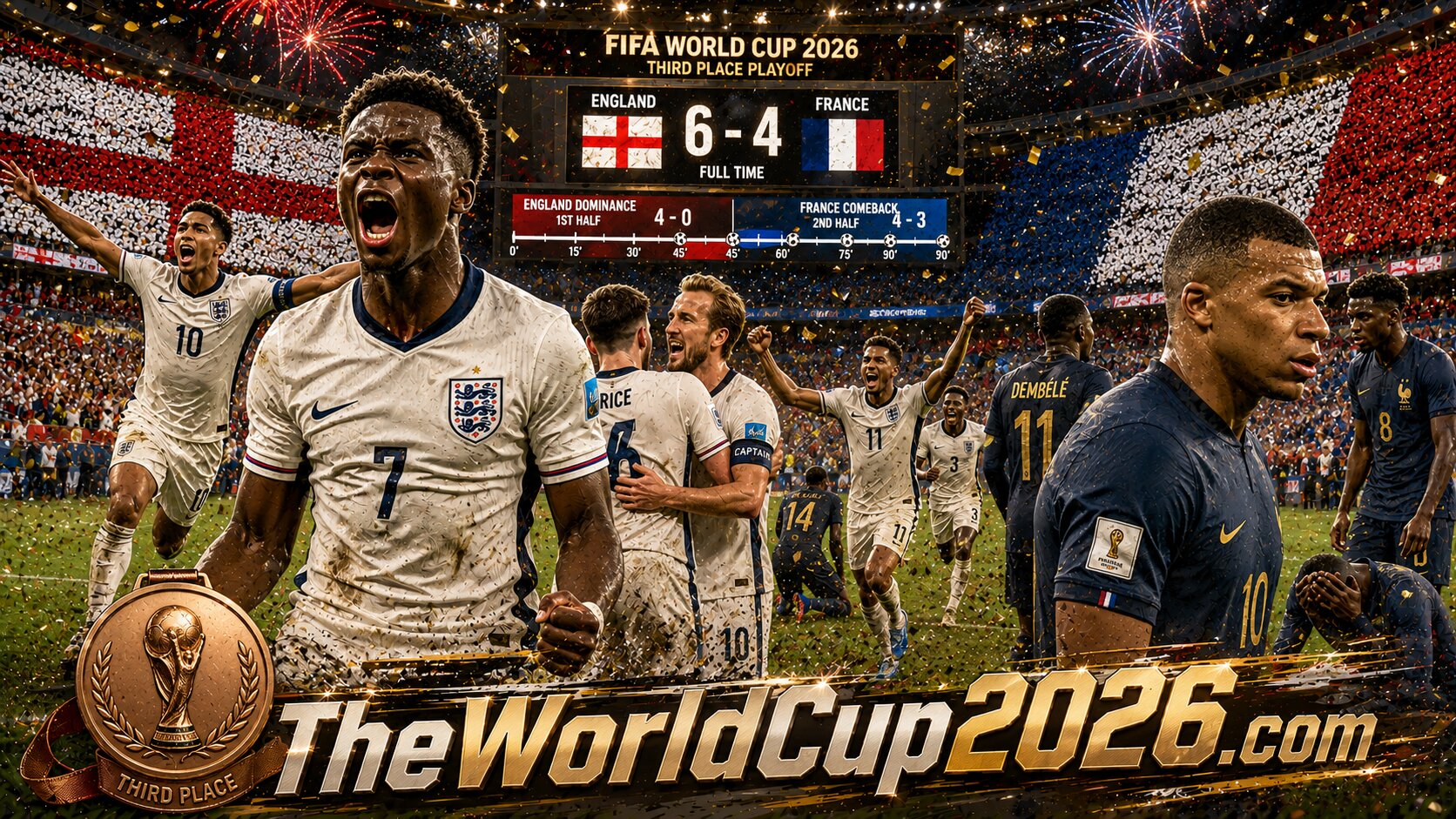
England 6–4 France World Cup 2026: Incredible 10-Goal World Cup Third-Place Thriller Analysis | FIFA World Cup 2026
There are football matches that become memorable.
There are football matches that become legendary.
And then there are matches that nobody who watched them will ever forget.
England’s astonishing 6-4 victory over France in the FIFA World Cup third-place playoff belongs firmly in that last category.
Coming into Saturday’s match in Miami, both teams were still nursing the emotional wounds of heartbreaking semifinal defeats. England had watched Lionel Messi inspire Argentina to a dramatic late comeback, while France had been outplayed by a brilliant Spanish side. Neither nation had reached the final they dreamed about, but both had one final opportunity to leave the tournament with pride, a medal, and momentum.
Instead of a cautious consolation match, the football world witnessed one of the most entertaining World Cup games ever played.
Ten goals.
A four-goal halftime lead.
An extraordinary French comeback.
A frantic final twenty minutes.
Historic individual performances.
Records broken.
And, ultimately, England securing its best World Cup finish since lifting the trophy at Wembley in 1966.
What the Match Meant Before Kickoff
Third-place matches often divide opinion.
Some players struggle to find motivation after losing a semifinal, while others embrace the opportunity to finish a World Cup with a victory.
England clearly belonged to the second group.
Thomas Tuchel had challenged his squad to respond positively after the painful 2-1 defeat to Argentina. Rather than dwell on what might have been, England sought to demonstrate that it remained one of the world’s elite national teams.
France had similar motivation.
Didier Deschamps, managing his final match before stepping down, hoped to end one of the greatest coaching careers in French football with a victory. Kylian Mbappé also entered the match chasing more World Cup history, already enjoying another extraordinary tournament.
England’s Dream First Half
Few expected England to dominate.
Nobody expected complete domination.
England attacked France from the opening whistle with remarkable intensity.
The midfield pressed aggressively.
The wide players attacked relentlessly.
France looked shocked.
Declan Rice opened the scoring almost immediately, setting the tone for an extraordinary first half. Ezri Konsa doubled the advantage before Bukayo Saka announced that he was about to produce the performance of his international career.
By halftime England led 4-0.
The scoreline accurately reflected the football.
England won nearly every midfield battle.
France repeatedly lost possession while trying to build from the back.
England’s pressing forced mistakes, while every transition seemed dangerous.
Thomas Tuchel’s tactical plan was working perfectly.
Rather than retreat into a defensive block, England attacked France high up the pitch, refusing to allow Mbappé or the French midfield time to organize attacks.
The strategy produced wave after wave of pressure.
France looked completely overwhelmed.
Video England 6-4 France World Cup 2026 Goals and Extended Highlights
Tactical Masterclass
England’s shape constantly shifted between a compact 4-2-3-1 and an aggressive pressing system whenever France attempted to play out from defense.
Declan Rice controlled central midfield.
Morgan Rogers and Bukayo Saka repeatedly exploited space behind France’s fullbacks.
Ivan Toney provided an outstanding physical reference point, allowing England to attack directly when necessary.
Most importantly, England recovered possession almost immediately after losing it.
France never established rhythm.
The opening forty-five minutes represented perhaps England’s finest tactical performance under Thomas Tuchel.
France Refuses to Surrender
Yet football has a remarkable ability to produce drama.
Whatever Didier Deschamps said during halftime worked.
France emerged transformed.
Instead of patiently building attacks, Les Bleus played with urgency.
They attacked directly.
They committed additional players forward.
Most importantly, Kylian Mbappé began finding space.
France quickly reduced the deficit.
Then another goal followed.
Suddenly England’s seemingly comfortable lead became increasingly fragile.
When France narrowed the score to 4-3, the stadium sensed something extraordinary.
Momentum had completely changed.
England suddenly looked nervous.
France believed.
What had appeared finished now became one of the greatest comeback attempts in World Cup history.
Mbappé Makes More History
Even in defeat, Kylian Mbappé reminded everyone why he remains one of football’s most feared attackers.
His two goals not only fueled France’s comeback but also carried historic significance.
The French captain surpassed Lionel Messi to become the leading scorer in World Cup history, adding yet another remarkable achievement to an already extraordinary international career.
Throughout the second half, every French attack seemed to involve Mbappé.
His pace stretched England.
His movement created opportunities.
His leadership inspired teammates who had looked defeated just forty-five minutes earlier.
Although France ultimately lost, Mbappé’s performance reinforced his reputation as one of football’s defining players.
Bukayo Saka’s Finest Hour
If Mbappé nearly rescued France, Bukayo Saka ultimately ensured England would celebrate.
Saka produced one of the greatest individual performances ever seen from an England player at a World Cup.
His hat-trick combined intelligent movement, clinical finishing and relentless work rate.
Whenever France threatened to seize momentum completely, Saka responded.
He consistently attacked defenders one-on-one.
He stretched France’s defensive line.
Most importantly, he finished chances with remarkable composure.
It was the performance England supporters have dreamed of seeing from one of their brightest stars.
Jude Bellingham’s Leadership
While Saka earned most headlines, Jude Bellingham again demonstrated why he may be the tournament’s outstanding midfielder.
His energy never disappeared.
He continued pressing even after France’s comeback.
Late in the match, with France desperately pushing for another equalizer, Bellingham broke away and scored England’s decisive sixth goal.
It perfectly summarized his tournament.
Technical quality.
Athleticism.
Leadership.
Big-game mentality.
Bellingham finished the World Cup with seven goals, further cementing his status among the world’s elite players.
Coaching Decisions
Thomas Tuchel deserves enormous credit.
England rotated heavily before kickoff, resting Harry Kane and introducing several fresh players into the starting lineup.
Some questioned those decisions.
Instead, they proved inspired.
Fresh legs allowed England to press aggressively throughout the first half.
Even when France mounted its comeback, England still possessed enough energy to attack on the counter.
Deschamps also deserves praise despite defeat.
His halftime tactical adjustments transformed the match.
France became significantly more aggressive.
The midfield advanced higher.
Mbappé received the ball earlier.
Wide players attacked with greater confidence.
Unfortunately for France, recovering from a four-goal halftime deficit against another elite nation proved simply too much.
Strengths and Weaknesses
England’s greatest strength throughout the tournament remained balance.
The Three Lions defended well.
Pressed effectively.
Created chances from multiple sources.
Against France they also demonstrated tremendous attacking depth.
However, England’s inability to control momentum after building a huge advantage remains an area Tuchel will surely analyze before future tournaments.
France displayed extraordinary resilience.
Very few teams could recover psychologically after trailing 4-0.
The comeback revealed impressive character.
Yet the disastrous opening forty-five minutes exposed lingering defensive vulnerabilities.
Repeated turnovers.
Slow defensive transitions.
Poor positioning under pressure.
Against elite opposition, those mistakes proved fatal.
What It Means for England
History will remember this tournament kindly.
England fell painfully short against Argentina.
Yet finishing third represents the country’s best World Cup performance since 1966.
Perhaps even more importantly, England now appears to possess a genuine golden generation entering its prime.
Bellingham.
Saka.
Rice.
Rogers.
Anthony Gordon.
Cole Palmer.
These players should form the backbone of England’s challenge at Euro 2028 and the 2030 World Cup.
The bronze medal may not erase semifinal disappointment.
But it confirms England belongs among football’s global elite.
What It Means for France
France leaves disappointed but hardly diminished.
This tournament once again demonstrated the extraordinary depth of French football.
Mbappé remains at his peak.
Several younger players gained invaluable experience.
The biggest change now comes on the touchline.
Saturday marked the end of Didier Deschamps’ remarkable era as France manager, concluding one of the most successful coaching tenures in international football.
England 6–4 France World Cup 2026: A Match That Will Never Be Forgotten
Years from now, supporters may struggle to remember every tactical adjustment or lineup change.
But everyone who watched this match will remember the feeling.
England storming into a 4-0 halftime lead.
France refusing to surrender.
Mbappé making history.
Saka completing a magnificent hat-trick.
Bellingham delivering the knockout blow.
Ten goals.
Constant drama.
Endless momentum swings.
For a match that technically decided only third place, it delivered football at its absolute best.
Sometimes the greatest gift football offers is unpredictability.
On July 18, 2026, England and France gave the world ninety unforgettable minutes—and reminded everyone why the FIFA World Cup remains the greatest sporting spectacle on Earth.
Stay on top of TheWorldCup2026.com!


