
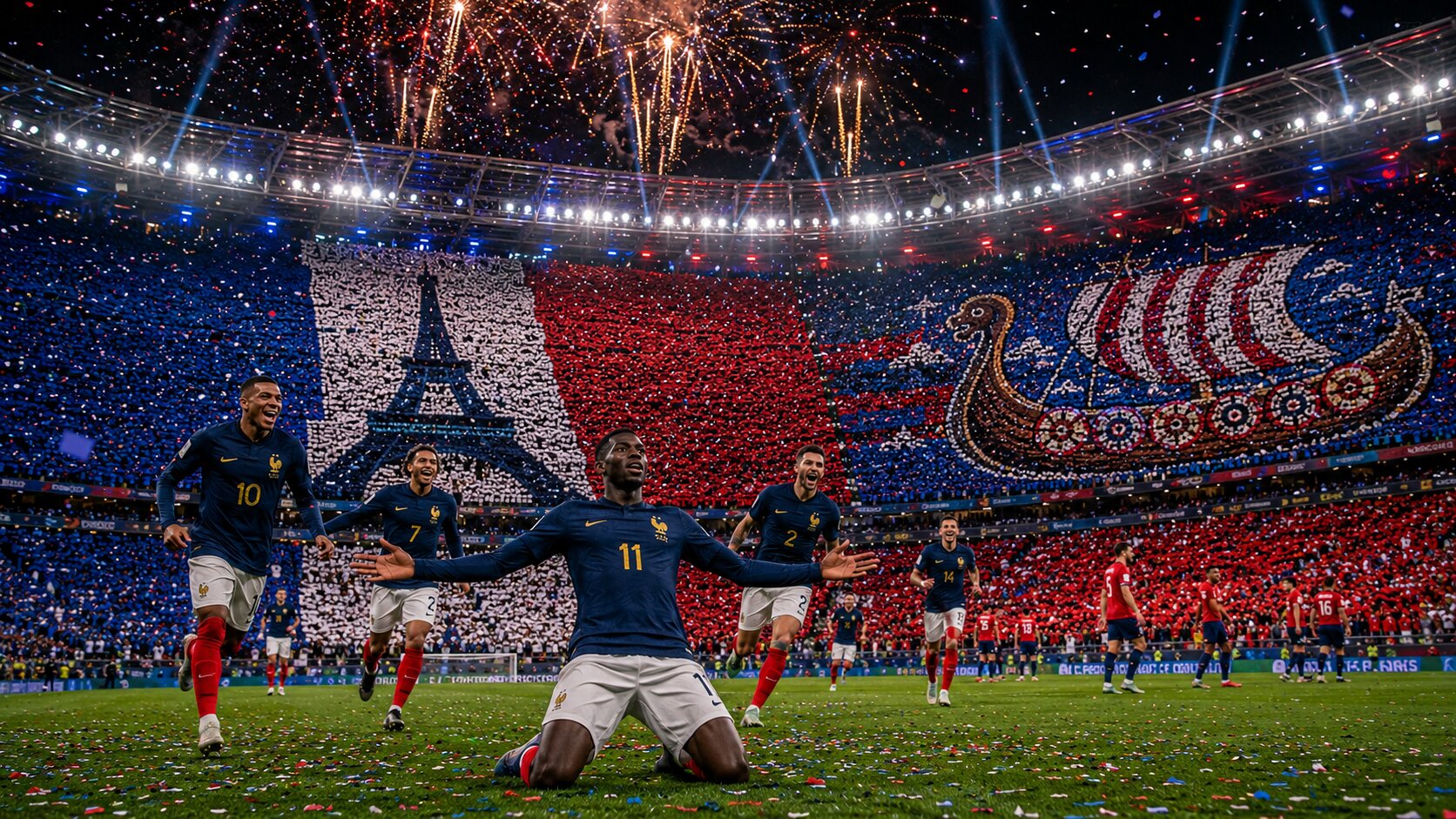
France 4-1 Norway highlights the powerful French team as the favorite to win the 2026 World Cup.
Every World Cup Produces a Performance That Makes the Rest of the Tournament Take Notice
France may have delivered that performance on June 25.
In a commanding 4-1 victory over Norway, Les Bleus produced the kind of complete display that sends a message not only to supporters, but to every remaining team in the competition.
The headline naturally belongs to Ousmane Dembélé.
The French star scored a spectacular hat trick and delivered one of the finest individual performances of World Cup 2026 so far.
But this result was about much more than one player.
It was about depth.
It was about confidence.
It was about tactical maturity.
And perhaps most importantly, it was about France demonstrating that it possesses every ingredient required to lift the World Cup trophy.
The final scoreline reflected France’s superiority.
Yet understanding the significance of the result requires examining an important detail.
Norway deliberately rested several key players.
Knowing that qualification for the knockout stage had already been secured, the Norwegian coaching staff elected to protect some of its biggest stars for the far more important challenges that lie ahead.
That decision shaped the match.
But it should not diminish what France accomplished.
If anything, it highlighted the enormous difference between a team merely preparing for the knockout rounds and a team that appears determined to dominate them.
Dembélé’s Night of Brilliance
Every great tournament eventually creates moments that become part of football folklore.
Dembélé may have created one.
From the opening minutes, he looked unstoppable.
His movement was intelligent.
His first touch was sharp.
His decision-making was excellent.
Most importantly, he attacked with confidence.
That confidence transformed every possession into a potential scoring opportunity.
The first goal showcased his instincts.
The second demonstrated his technical quality.
The third completed a hat trick that instantly became one of the defining individual performances of the group stage.
What made the achievement especially impressive was the variety.
These were not three identical goals.
Each reflected a different aspect of Dembélé’s game.
Finishing.
Positioning.
Creativity.
Composure.
For years, football supporters have debated Dembélé’s immense potential.
Against Norway, that potential became reality.
France 4-1 Norway Video with Goals and Highlights
The Evolution of Ousmane Dembélé
For much of his career, Dembélé has been viewed as one of football’s most gifted talents.
The challenge was consistency.
There were periods when injuries interrupted his progress.
There were moments when his decision-making occasionally lagged behind his extraordinary ability.
At World Cup 2026, however, France appears to be benefiting from the most complete version of Dembélé ever seen.
He remains explosive.
He remains unpredictable.
But he has added maturity.
Against Norway, every action appeared purposeful.
Every run had intent.
Every touch seemed designed to create danger.
That combination makes him one of the most dangerous players remaining in the tournament.
If he maintains this level, the Golden Boot conversation may suddenly become much more interesting.
France Controlled Every Area of the Pitch
Although Dembélé deserved the spotlight, France’s dominance was collective.
The midfield dictated the tempo from the opening whistle.
The defense remained organized.
The pressing consistently disrupted Norway’s attempts to build possession.
Most impressive was France’s balance.
Many attacking teams become vulnerable when committing players forward.
France rarely looked exposed.
Whenever Norway attempted to counterattack, Les Bleus quickly recovered their shape.
The result was sustained pressure without significant defensive risk.
Championship teams often display this quality.
They attack aggressively while remaining structurally disciplined.
France accomplished both.
Why Norway Chose to Rest Its Stars
The most important tactical storyline before kickoff involved Norway’s lineup.
Having already secured progression to the knockout stage, the coaching staff made the understandable decision to prioritize long-term tournament success over a single group-stage result.
Several regular starters were either rested entirely or saw limited action.
The logic was straightforward.
The knockout rounds matter more.
Fatigue accumulates quickly during a World Cup.
Protecting key players reduces injury risk and preserves energy for elimination matches.
Many successful World Cup teams have followed similar strategies in previous tournaments.
Norway’s decision was reasonable.
Yet it came with consequences.
The absence of several established starters reduced chemistry, experience, and attacking threat.
Against a team as strong as France, those differences became increasingly apparent.
What the Match Revealed About Norway
Despite the defeat, Norway should not panic.
The coaching staff largely achieved its primary objective.
Important players received rest.
The squad avoided major injuries.
Qualification had already been secured.
From a strategic perspective, the long-term picture remains positive.
At the same time, the match exposed several concerns.
The squad depth remains good, but perhaps not yet equal to the world’s elite teams.
When key figures are unavailable, Norway’s overall quality declines noticeably.
That is not unusual.
Most national teams depend heavily on their best players.
The difference is that Norway may depend on them more than some of the other contenders.
The good news is that those players will return for the knockout rounds.
And when they do, Norway becomes a completely different proposition.
The Shadow of Erling Haaland
Even when not central to the action, Erling Haaland remains the player opponents fear most.
France clearly respected that reality.
Defenders remained aware of his positioning.
Midfielders tracked transition opportunities carefully.
The tactical preparation devoted to Haaland demonstrated his influence.
The knockout rounds will provide a more accurate measure of Norway’s true level because they will likely feature a fully strengthened lineup built around their superstar striker.
If Norway can combine freshness with tactical discipline, they remain capable of causing problems for any opponent.
Why France Looks Like the Tournament Favorite
Several teams entered World Cup 2026 carrying championship expectations.
Brazil.
Argentina.
England.
Spain.
Portugal.
Germany.
France now appears to have separated itself slightly from that group.
The reasons are becoming increasingly difficult to ignore.
First, the squad possesses elite talent in every area.
Second, the team combines experience with youthful energy.
Third, multiple players can decide matches.
Opponents cannot focus on stopping just one star.
Stop Dembélé, and another threat emerges.
Control the midfield, and France attacks from wide areas.
Defend deep, and France possesses creators capable of unlocking compact defenses.
Few teams offer so many solutions.
The Depth That Wins Championships
World Cups are rarely won by starting lineups alone.
Eventually injuries occur.
Suspensions happen.
Fatigue accumulates.
Champions survive because their depth allows them to absorb adversity.
France may possess the deepest squad in the tournament.
Several players capable of starting for almost any national team begin matches on the bench.
That luxury becomes increasingly valuable as the competition progresses.
When knockout matches reach extra time, depth often becomes decisive.
France appears exceptionally well positioned in that regard.
The Knockout Stage Outlook
France now enters the elimination rounds carrying enormous momentum.
Confidence is high.
The attack is firing.
The defense remains organized.
The squad is healthy.
Perhaps most importantly, the players appear to believe they are the best team in the tournament.
That belief can become a powerful weapon.
Norway enters the knockout stage with a different mindset.
The defeat hurts, but it also arrives under circumstances that make it easier to contextualize.
The coaching staff prioritized the future.
Now that future has arrived.
With rested stars returning, Norway becomes one of the most intriguing dark horses remaining.
No contender will welcome the prospect of facing them.
Final Thoughts
France’s 4-1 victory over Norway may eventually be remembered as one of the defining performances of the group stage.
Ousmane Dembélé delivered a hat trick for the ages.
The French midfield controlled the match.
The defense remained composed.
The entire team performed with the confidence of a champion.
Norway, meanwhile, made a calculated decision to prioritize the knockout rounds over immediate results.
That choice may still prove wise.
A fully rested Norway remains a dangerous team capable of upsetting more established powers.
Yet on this particular night, the spotlight belonged entirely to France.
The performance was dominant.
The message was unmistakable.
World Cup 2026 still features many contenders.
But after watching Les Bleus dismantle Norway, one conclusion feels increasingly difficult to avoid:
If another nation wants to lift the trophy next month, it may have to go through France first.
Could This Be France’s Best World Cup Team Since 2018?
That question may sound premature.
After all, the knockout rounds have not yet begun.
Yet it is becoming increasingly difficult to ignore the similarities between this French squad and the team that lifted the World Cup eight years ago.
Like that team, France possesses elite attacking talent.
Like that team, France has extraordinary depth.
Like that team, France appears capable of winning matches in multiple ways.
Some opponents will force open, attacking contests.
France can win those.
Others will attempt to defend deep and frustrate.
France appears capable of winning those as well.
Championship teams rarely depend on a single formula.
The best teams adapt.
France is adapting beautifully.
What makes this squad especially dangerous is that it may still have another level to reach.
Dembélé is in spectacular form.
The midfield continues improving.
The defense looks increasingly comfortable.
And several world-class players have yet to produce their very best football.
That should concern every remaining contender.
The Growing Race for the Golden Boot
Dembélé’s hat trick also transformed another important storyline.
The Golden Boot race.
Every World Cup develops individual competitions alongside the race for the trophy itself.
The battle to become the tournament’s leading scorer is one of the most prestigious.
Before this match, much of the attention focused on players such as Lionel Messi, Kylian Mbappé, Erling Haaland, Vinícius Júnior, and other established stars.
Dembélé has now firmly entered that conversation.
If France continues advancing deep into the tournament, opportunities will continue arriving.
The quality of service around him is exceptional.
The confidence level is soaring.
And confidence can be everything for an attacking player.
A striker who believes every chance will become a goal is often the most dangerous player on the pitch.
Dembélé currently looks like exactly that kind of player.
Why Norway Remains Dangerous
It would be a mistake to judge Norway solely through the lens of this result.
Context matters.
This was not the strongest version of Norway.
The coaching staff made a deliberate decision to prioritize freshness and squad management.
When the knockout rounds begin, opponents should expect a much stronger side.
The core qualities that helped Norway reach this stage remain intact.
Physicality.
Discipline.
Direct attacking threat.
And, of course, world-class finishing.
The defeat may even prove useful.
Sometimes a setback sharpens focus.
Sometimes it removes complacency.
Sometimes it reminds a team how small the margins become at World Cups.
Norway now enters the knockout rounds knowing exactly what level will be required.
That knowledge can be valuable.
What the Rest of the Tournament Learned
Perhaps the most important consequence of this match extends beyond either team.
The rest of the World Cup field was watching.
Brazil watched.
Argentina watched.
England watched.
Spain watched.
Portugal watched.
And they all saw the same thing.
France is operating at an extremely high level.
The attack is producing goals.
The midfield is controlling matches.
The defense is limiting opportunities.
The squad depth is remarkable.
No team is unbeatable.
World Cup history proves that every four years.
Yet after three group-stage matches, France has built one of the strongest championship cases in the tournament.
The challenge now becomes maintaining that level.
History shows that becoming a favorite is easier than remaining one.
The pressure grows.
Expectations increase.
Every opponent raises its level.
France must embrace those realities.
Based on current evidence, they appear fully capable of doing so.
Final Verdict
France’s 4-1 victory over Norway was more than an impressive result.
It was a declaration.
A declaration that Les Bleus possess the talent, depth, experience, and confidence required to win the FIFA World Cup 2026.
Ousmane Dembélé delivered one of the tournament’s greatest individual performances with a magnificent hat trick.
The midfield controlled the rhythm.
The defense remained composed.
The entire team looked comfortable carrying the weight of expectation.
Norway leaves the group stage with a defeat but also with perspective.
The primary goal—advancing to the knockout rounds—has been achieved.
The rested stars will return.
The opportunity remains alive.
For France, however, the message was unmistakable.
This was not simply a victory.
It was a warning.
The road to the World Cup trophy may now run directly through Les Bleus.
Keep up with Word Cup 2026 results, highlights, analyses and much more in TheWorldCup2026.com


